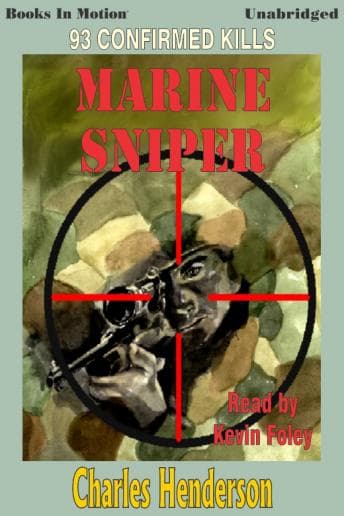

Carlos Hathcock is the real deal, and if you've spent any time around Marines, you've heard his name spoken with something close to reverence. Ninety-three confirmed kills in Vietnam. The white feather in his bush hat. The crawl. If you haven't heard about any of this, strap in.
I finished this one on a late-night drive back from a client site in San Antonio, Ranger asleep in the back seat, and I sat in my driveway for twenty minutes because I couldn't turn it off during the scope-shot sequence. You know the one — Hathcock puts a round clean through an enemy sniper's scope, meaning that shooter was lining up on him at the exact same moment. The math on that, the timing, the sheer cold-bloodedness required — Henderson lays it out and Kevin Foley delivers it with the kind of measured calm that makes your grip tighten on the steering wheel.
The Crawl That'll Make Your Back Hurt Just Listening
The centerpiece of this book, and the part that separates it from every other military biography I've listened to, is the multi-day crawl across open terrain to eliminate an NVA general. Henderson commits serious page time (or in this case, serious audio time) to this mission, and it works because he doesn't rush it. You feel every inch. Hathcock inching forward through grass while fire ants are eating him alive, the sun cooking the back of his neck, enemy patrols stepping within feet of him. I've done low crawls in training and they're miserable for fifty meters. This man did it for days.
Here's where the book gets interesting as a piece of writing, though — and where it also stumbles a bit. Henderson wrote this as nonfiction, but the metadata tags it as "Fiction & Literature," and honestly, I can see why there's confusion. The narrative reads novelized. Henderson puts you inside Hathcock's head, reconstructs dialogue, builds scenes like a thriller writer would. That's both the book's strength and its weakness. It makes for a hell of a listen. But there are moments where you wonder how much is documented and how much is Henderson filling gaps with educated guesses. He was close with Hathcock, so I'll give him more latitude than I'd give some journalist parachuting into the story, but it's worth knowing going in.
Kevin Foley Keeps His Ego Out of the Way
Let me cut to the chase on the narration: Foley is solid. He's not doing vocal gymnastics, he's not trying to give every Vietnamese character some exaggerated accent (thank God), and he's not whispering dramatically during tense scenes like some narrators who think they're directing a movie. He reads it straight, with good pacing and a voice that sounds like it belongs talking about men doing hard things in hard places. The Earphones Award is deserved.
That said, I wouldn't call it a performance that elevates the material the way some great narrator-book pairings do. It's competent and professional. The story does the heavy lifting. Foley carries it without dropping it, which at 10 hours and 54 minutes is no small thing.
I listened at my usual 1.25x and it felt right. Foley's natural pace is deliberate — good for the tension-building sections but a touch slow during the biographical background chapters about Hathcock's childhood and early career. Bumping the speed keeps those stretches from dragging.
Where It Gets Personal
I've seen this scenario play out in real life — not the sniper specifics, but the way the military builds legends. Some of those legends are inflated. Some are undersold because the men involved won't talk about what happened. Hathcock was the rare case where the legend and the man seem to line up pretty close. What Henderson captures well is the cost. The burn injuries from the amtrac incident, the physical deterioration, the way Hathcock couldn't stop being a Marine even when his body was done. That's the part Linda wouldn't expect me to connect with, but any career military person reading this knows — the mission doesn't leave you when you leave the mission.
The book does lean heavily into hero worship at times. Henderson clearly admired Hathcock, and the prose occasionally drifts into a reverent tone that a more critical biographer might have tempered. But I'd rather have a book written by someone who cared deeply about the subject than some detached academic treatment. You feel Henderson's respect on every page, and Foley conveys it without making it saccharine.
Worth Your Time? Here's the Debrief
If you're into military history, this is essential listening. Period. If you've read the print version, Foley's narration adds enough to justify the audio format — the pacing during combat sequences particularly benefits from being heard rather than read. If military books aren't your thing, this probably won't convert you, but it's one of the best entry points into the genre.
Who should skip it? Anyone who needs rigorous source citations and journalistic distance. This is a love letter written by a Marine about a Marine, and it reads like one. That's not a flaw in my book, but know what you're getting. The last book that gave me that same feeling — a narrator so personally invested in the subject that the admiration bleeds through every sentence — was It, where King's love for those characters is almost embarrassingly visible on the page.
Ranger approved this one. He perked up during the crawl sequence, which either means he sensed the tension or heard a squirrel. I'll take it either way.