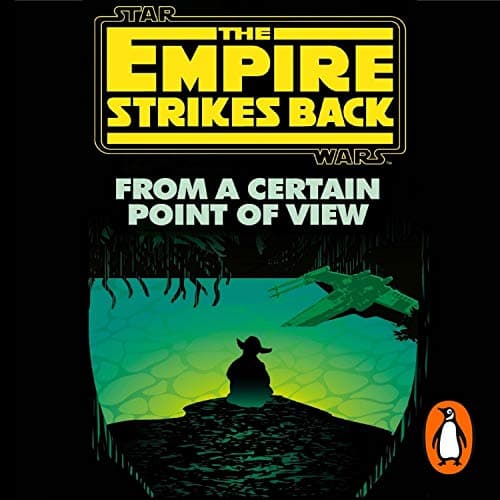

What happens when you hand forty authors a single movie and say "pick a background character, any background character"?
I started this at 11PM after a particularly brutal day of chasing a memory leak through three microservices. Kevin was already asleep, and I figured a Star Wars anthology would be low-stakes enough to wind down with. Four hours later I was sitting in the dark kitchen, earbuds in, genuinely emotional about a wampa. A wampa. Mark Oshiro wrote a story about the creature Luke hacks on Hoth and somehow turned it into this gut-punch about loss and survival, and I'm sitting there at 3AM thinking about how I never considered what happened to that thing after the scene cut away.
That's basically the thesis of this entire collection: every extra in every frame has a story, and some of those stories are better than they have any right to be.
Forty Stories, Forty Dice Rolls
Let's be honest about the math here. Forty short stories means you're getting a distribution, not a consistent experience. Some of these are incredible - Seth Dickinson's piece about an Imperial officer on a doomed Star Destroyer reads like his Baru Cormorant work distilled into forty minutes, all moral compromise and the slow realization that you're expendable to the system you serve. Martha Wells writing Ugnaught labor politics in Cloud City? That's basically Murderbot but for blue-collar aliens, and it works way better than it should. Hank Green doing a nature documentary narrator voice for tauntaun husbandry on Hoth is the kind of thing that sounds like a joke pitch and lands as genuinely charming worldbuilding.
But some stories are just... fine. There's a long middle section of the anthology where you're bouncing between authors you've never heard of writing about characters you barely remember, and the quality dips into "nice fanfic" territory. Not bad, just not earning the 18-hour runtime. I'd estimate maybe 25 of the 40 stories are worth your attention, 10 are forgettable, and 5 are genuinely excellent. I ran into the same uneven buffet problem with Legacy, where the hit rate felt about the same and the forgettable middle dragged harder than it should have. That's a pretty good hit rate for an anthology, but it means you'll have stretches where you're zoning out.
Nine Narrators Playing Musical Chairs
The narrator rotation is both the biggest strength and the weirdest quirk of this production. Nine readers for forty stories means each narrator covers multiple pieces, and the transitions between them create these tonal whiplash moments. Sam Witwer brings this intense, almost too-earnest energy that's perfect for the darker Imperial stories. Marc Thompson - who's basically the default Star Wars audiobook voice at this point - handles the more action-oriented pieces with the kind of practiced ease you'd expect. Jon Hamm shows up and you spend the first thirty seconds going "wait, is that Don Draper reading Star Wars?" before his delivery wins you over.
January LaVoy and Emily Woo Zeller handle some of the more emotionally complex stories, and Dion Graham's bass register gives weight to pieces that could've felt lightweight. But here's the thing - with nine narrators rotating through, there's no single voice anchoring the experience. If you're used to a consistent narrator building atmosphere over hours (Ray Porter this is not), the constant switching can feel like channel surfing. I adjusted to it by about hour three, but fair warning.
The Commute-Worthiness Problem
Here's where I land on this: the short story format is both ideal and terrible for commuting. Ideal because each story is roughly 20-30 minutes, which means you can finish one per train ride and get that satisfying completion dopamine. Terrible because if you zone out during a transition between stories - which you WILL at 6AM on a Tuesday - you'll suddenly be three minutes into a completely different narrative with a different narrator and no idea what's happening. I missed the opening of R. F. Kuang's story twice because I was half-asleep during the handoff and had to scrub back.
At 1.5x this runs about 12 hours, so roughly six commutes for me. The pacing is uneven enough that I bumped certain stories to 1.75x (the business-book speed, reserved for stories that were clearly padding their page count with Star Wars wiki entries disguised as prose).
Perfect for: train, gym, weekend chores. Skip for: deep focus work, anything where you can't easily scrub back.
Who Gets the Lightsaber, Who Gets the Door
Pick this up if you're a Star Wars fan who's ever watched Empire and wondered about the people in the background. If you've read any of the contributing authors - especially Dickinson, Wells, or Kuang - their stories alone justify the time investment. Skip it if you need narrative momentum across a full audiobook or if you're not already invested in the Star Wars universe; without that context, half these stories lose their punch because you won't know which background extra is getting their spotlight moment.
The ROI on this audiobook is weird to calculate. You're not getting one great 18-hour story. You're getting a buffet where maybe 60% of the dishes are good to great, and the rest are edible. The charity angle is genuinely cool (all author proceeds go to First Book), so there's that too.
Ship It With Caveats
I wouldn't call this essential Star Wars listening, but I also can't stop thinking about that wampa story, and Seth Dickinson's Imperial officer piece is going to rattle around in my head for weeks. The best entries here do something the movies never could - they make you care about the extras. The worst entries remind you why most extras don't get speaking roles. I finished this in about six commutes and I'm glad I did, even if I could've skipped a third of it without losing much.