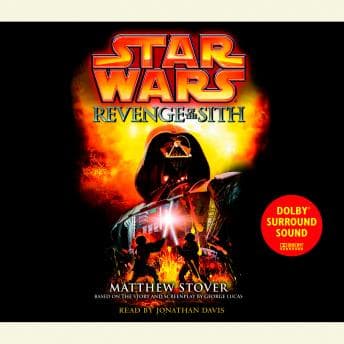

"This is how it feels to be Anakin Skywalker, forever."
That line hit me somewhere around hour six, and I had to pause my thesis procrastination to just... sit with it. Look, I've watched Revenge of the Sith probably thirty times. I've memed about the high ground. I've quoted "I am the Senate" at my D&D group until they threatened to revoke my snack privileges. But Matthew Stover's novelization? This is the version that made me actually understand Anakin's fall. Not excuse it—understand it.
The Novelization That Shouldn't Work (But Absolutely Does)
Here's the thing about movie novelizations: they're usually just the screenplay with "he said" tacked on. Stover doesn't do that. He gets inside these characters' heads in ways the film literally cannot. The opening battle over Coruscant becomes this philosophical meditation on war and friendship and the nature of heroism, all while Anakin and Obi-Wan are dodging vulture droids. That blend of action and philosophy reminds me of the speculative depth in Five Sci-Fi Short Stories by H. Beam Piper, though Piper's working with very different stakes. It's like if Brandon Sanderson decided to write Star Wars but kept all the tragedy.
The Anakin chapters especially—Stover writes his internal conflict as this constant, exhausting war between who he wants to be and who Palpatine is slowly convincing him he already is. When he's standing in the Jedi Temple, about to make the worst decision in galactic history, you feel the weight of every sleepless night, every vision of Padmé dying, every moment the Jedi Council made him feel like a weapon instead of a person. It's Sanderson-level character work, honestly. The magic system here is just "how do you corrupt a good man," and Stover nails every beat.
Jonathan Davis and the Art of Vocal Tragedy
Okay, so Jonathan Davis. I'd put him in my top tier of Star Wars narrators, easy. His Palpatine is genuinely unsettling—all that manipulative charm dripping with false warmth, and you can hear the Sith Lord underneath even when he's playing concerned mentor. But it's his Obi-Wan that got me. There's this weary determination in the voice, like a man who knows everything is falling apart but keeps fighting anyway because that's what Jedi do.
The character voices are distinct without being cartoonish. His Yoda sounds wise rather than gimmicky. His Mace Windu carries that barely-contained frustration with Anakin that the film only hints at. And when Anakin finally breaks—when he becomes Vader—Davis shifts the vocal register in this subtle way that made my skin crawl. It's not just "now he sounds evil." It's "now he sounds hollow."
The production quality deserves a shoutout too. Sound effects and music woven throughout, which normally I'm skeptical about (audiobooks don't need to be radio dramas, fight me), but here it works. The lightsaber hums during duels, the rumble of ships—it enhances without overwhelming. My D&D group would lose their minds over this level of immersion.
Where the Screenplay Limits the Story
I'm not going to pretend this is flawless. The pacing in the middle section drags a bit—there's only so much Stover can do when he's bound to the film's structure, and some of the political maneuvering scenes feel like they're marking time until the next big moment. If you're not already invested in the prequel-era politics, those sections might have you checking how much runtime is left.
And look, if you hate the prequels' fundamental story choices—if you think Anakin's turn is too fast or the romance with Padmé is too stilted—this won't completely fix that. It makes it better, way better, but it can't rewrite the skeleton of the plot. The source material is what it is.
But here's the thing: for everyone who felt like the movie rushed Anakin's fall, this is the version that earns it. Thirteen hours gives Stover room to breathe, to show us the thousand small compromises that lead to one catastrophic choice.
Would I Listen Again?
Already have. Twice. (Don't tell Dr. Patel.)
This is the rare novelization that improves on its source material. It's not just "the movie but longer"—it's a genuine exploration of tragedy, of how good intentions curdle into atrocity, of what it costs to watch someone you love become a monster. Jonathan Davis delivers it all with the kind of performance that makes you forget you're listening to one guy in a booth.
If you're a Star Wars fan who's ever wanted to understand why Anakin's story matters beyond the memes, this is it. Skip it if you've never cared about the prequels and don't plan to start—this probably won't convert you. But for the rest of us—the ones who grew up watching this tragedy unfold and always wished we could feel it more deeply—yeah. This is how it feels to be Anakin Skywalker, forever. And it hurts exactly as much as it should.