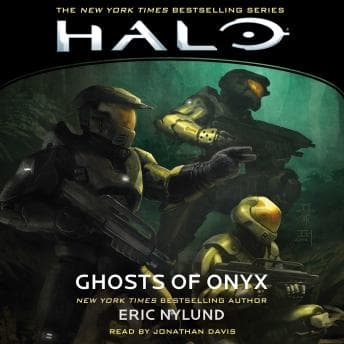

"Spartans never die, they're just missing in action." Yeah, well, Eric Nylund clearly didn't get that memo.
I started listening to Ghosts of Onyx at 2 AM while staring at a segmentation fault in my thesis code that I've been ignoring for three days. (Sorry, Dr. Patel. The pathfinding algorithm is broken, and so is my spirit.) I needed something punchy. Something where the rules are clear, unlike my future in academia.
And man, does Nylund deliver.
Jonathan Davis: The Voice of the UNSC
Okay, let's talk about the audio. Jonathan Davis is the narrator here. Is he Steven Pacey? No. But honestly, for military sci-fi, you don't want a bard. You want a soldier.
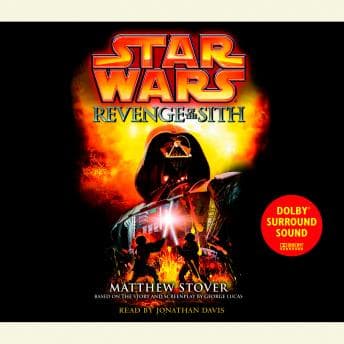
Davis has this steady, precise cadence that just works. Warm, but with that clipped, military efficiency. He brings that same controlled intensity to Star Wars: Episode III: Revenge of the Sith, where the military briefings and Jedi Council scenes need exactly that kind of gravitas. When he reads the technical specs of the SPI armor or the tactical readouts, it sounds right. Like an ONI briefing you're not supposed to be hearing.
He doesn't do wild, distinct accents for every single grunt or elite, which usually bugs me—I want my distinct voices!—but here? It actually fits. Creates this cohesive, sterile-yet-human military atmosphere. I listened to about four hours straight while grinding XP in an MMO (don't ask which one), and his voice never got grating. That's a win in my book.
When the Timeline Glitches
Here's the thing, though. And this is where I almost threw my headphones across the room.
The structure is... messy. Like spaghetti code before you refactor it. We're jumping from 2545 to 2552, then back to 2531. If you're zoning out—or if you're trying to explain a magic system to someone at a party while listening with one earbud in (hypothetically)—you're going to get lost.
There were moments I had to check my phone to figure out when we were. Not Davis's fault. He reads the timestamps clearly. It's just a lot of context switching. If you're used to linear progression fantasy, this might annoy you. But stick with it. Once the threads merge on Onyx? Chef's kiss.
The Crunchy Lore (My Favorite Part)
Look, I read fantasy for the hard magic systems, and I read Halo books for the military logistics. Nylund gets this.
This isn't just Master Chief being a tank. This is about the Spartan-III program. The disposable heroes. The ones made with cheaper tech and shorter training times to be thrown into the meat grinder. It's dark. Way darker than the games usually get.
Listening to the training sequences for Beta Company gave me serious Ender's Game vibes, but with more plasma grenades. That same blend of tactical depth and world-building complexity shows up in Dark Tower II: The Drawing of the Three, where King builds his gunslinger mythology with the same kind of systematic precision. As someone who spends way too much time thinking about procedural generation and systems, seeing how Ackerson built a new Spartan program from the ground up was fascinating. It's the "stat block" stuff I live for.
If you want to know why the Halo universe works the way it does, you listen to this. It explains the Forerunner tech in a way that feels ancient and terrifying, not just "generic video game dungeon."
Who's This For?
If you love crunchy military logistics, Forerunner lore deep-dives, and don't mind some timeline-hopping, this is your jam. Skip it if you need linear storytelling or you're looking for Master Chief action—he's barely in this one.
Bug Report: Would Not Fix
I finished this instead of fixing my thesis bug. The ending hit me right in the feels—Kurt-051 is a legend—and now I'm browsing the wiki instead of sleeping. Mission accomplished, I guess.