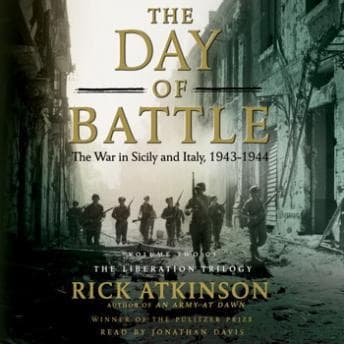
Couldn't sleep last Tuesday. Linda was out cold, Ranger was snoring at the foot of the bed, and my brain wouldn't shut off after a long day sorting through a client's vulnerability assessment. So I did what I always do at 0200 when sleep won't come — I put in the earbuds and fired up the next chapter of Rick Atkinson's Day of Battle. Thirty-two hours and forty minutes of the Italian campaign. I'd been chipping away at it for weeks. And lying there in the dark, listening to the disaster at the Rapido River crossing, I felt something I haven't felt since I was a young officer reading unit after-action reviews: genuine anger at command decisions made eighty years ago.
Let me cut to the chase. This is the real deal. Atkinson's second volume in his Liberation Trilogy covers the invasion of Sicily through the liberation of Rome, and it is dense, brutal, and unflinching. Worth your time? Absolutely — if you're willing to commit.
The Fog of War Has Never Been This Clear
Atkinson does something rare for a historian — he toggles between the strategic arguments happening in Allied conference rooms and the squad-level horror of guys trying to cross a river under direct fire. The political knife-fighting between Churchill and Roosevelt over whether Italy was even worth the blood gets as much attention as the actual blood. And that's the right call. Because the Italian campaign was fundamentally a strategic argument that real people died inside of.
Mark Clark is the gravitational center here, and Atkinson doesn't let him off easy. The portrait that emerges is of a general so consumed by personal glory — particularly the race to Rome — that operational decisions bent around his ego. I've served under officers like that. Not at that scale, thank God, but the personality type is unmistakable. Atkinson documents Clark's obsession with press coverage, his tension with the British, his questionable calls at Anzio — all without turning it into a hit piece. He lets the primary sources do the talking, and they talk plenty.
The author clearly did their homework. The level of primary source material — letters, diaries, unit records, after-action reports — is staggering. The Autobiography of Benjamin Franklin gave me a similar feeling — that rare sense of a writer who lived inside his subject matter so completely that the research disappears and only the man remains. You can feel the weight of the research. When Atkinson describes the conditions at Cassino, the mud and cold and the medieval monastery looming above like a stone skull, he's drawing from dozens of firsthand accounts stitched together into something that reads — or in this case, sounds — almost like a novel.
Jonathan Davis and the 32-Hour March
Here's where I need to be honest. Jonathan Davis delivers the narration with a calm, controlled approach that someone at AudioFile magazine described as "Homeric," and I get that. His voice modulates well — quiet when quoting a scared private's diary entry, measured when laying out strategic context, with enough gravity during the worst moments. He doesn't do distracting character voices, which for a book like this is the right play. Atkinson identifies speakers, Davis adjusts his inflection slightly, and you always know who's talking.
But — and this is a real "but" — over thirty-two hours, that steadiness can work against him. There were stretches, particularly through some of the political back-and-forth chapters, where I needed to bump up to 1.5x just to stay locked in. At 1.25x (my standard), some of the strategic debate sections dragged. Not because the content was weak, but because the narration didn't shift gears enough to signal "hey, pay attention, this matters." When you're doing a book this long, you need peaks and valleys in energy. Davis gives you a rolling hill when sometimes you need a cliff.
I've heard the first book in this trilogy had a different narrator who some folks preferred. I can see why that complaint exists, even though Davis is solid. He's a B+ narrator carrying A+ material. Not a dealbreaker. Just something to know going in.
Where It Lost Me (Briefly) and Where It Wrecked Me
This is where it lost me: some of the middle sections covering the Salerno beachhead politics felt like they could've been tightened. Atkinson is thorough to a fault sometimes, and in audio form, you can't skim. You're committed to every sentence. In print I'd have skimmed a paragraph or two. In audio, you ride it out.
But then you hit the Rapido River. The absolute catastrophe of the 36th Division's crossing attempt — the boats falling apart, the German fire cutting men down in the water, the recriminations afterward. Atkinson writes it with barely contained fury, and Davis's voice gets this quiet edge that hit me hard. I've seen rivers crossed under fire. Not like that, not that bad. But enough to know what that water sounds like when it's full of guys who aren't making it across. I had to pause and just lie there in the dark for a minute.
That's what separates Atkinson from the History Channel crowd. He earns the emotional moments with research, not rhetoric.
Who Should Enlist for This One
If you're a WWII history reader who actually wants to understand the campaign nobody talks about — not Normandy, not the Bulge, but the ugly forgotten slog up Italy — this is your book. Military professionals, history nerds, anyone who wants to understand how strategic indecision costs lives. If you want explosions-per-chapter, this isn't it. This is the long game. The logistics, the politics, the human cost.
Skip it if you need fast pacing or can't commit to 32+ hours. This is not background listening. Ranger fell asleep during the supply chain chapters, and honestly, I nearly joined him once or twice.
Mission Debrief
Rick Atkinson wrote the definitive account of the Italian campaign, and Jonathan Davis delivers it with enough skill to carry you through a marathon listen. It's not perfect — the length tests your endurance and the narration occasionally flatlines during political chapters. But when it's firing on all cylinders, when Atkinson drops you into the mud at Cassino or the chaos at Anzio, this is military history at its absolute best. I finished the last chapter at 0430 on a Wednesday morning, Ranger's head on my knee, and immediately downloaded the third volume.
Ranger approved this one. And so do I.








![Steve Jobs [unabridged audiobook] audiobook cover](/_next/image?url=https%3A%2F%2Fcovers.audiobooks.com%2Fimages%2Fcovers%2Ffull%2F9788499923406.jpg&w=1920&q=75)