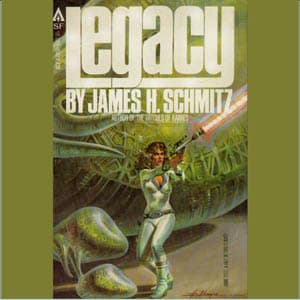

So I went into this expecting dated 60s sci-fi cheese. You know the type - women exist to be rescued, aliens are just humans with weird foreheads, science is basically magic with extra steps. And for the first twenty minutes, I was mentally composing my "skip this" review while stuck on a delayed Caltrain at Millbrae.
Then Trigger Argee kicked someone through a wall.
1962 Called, It Wants Credit For Inventing Competent Women
Here's what nobody told me about James H. Schmitz: the man was writing genuinely capable female protagonists when most sci-fi authors were still treating women like furniture that occasionally screamed. Trigger isn't just "strong female character" in that annoying way where strength means punching things. She's a government agent, a martial arts expert, AND she outthinks most of the men around her. In 1962.
The plot involves these ancient biological machines called plasmoids - think sentient goo that an extinct alien civilization created and then immediately regretted. Trigger's mentor Holati Tate discovered them, then vanished. Now everyone from intelligence agencies to criminal syndicates wants Trigger either as an asset or a corpse. The mystery of why the plasmoids are suddenly waking up after millennia of dormancy kept me genuinely engaged through three morning commutes.
Schmitz does this interesting thing where the plasmoids aren't just McGuffins. There's actual worldbuilding around what they are, why the Old Galaxy Masters exiled them, and what happens when humanity starts poking at technology we don't understand. The science doesn't hold up to modern scrutiny (this is basically nanotech before we had the vocabulary for nanotech), but the concepts are surprisingly sophisticated for the era.
The LibriVox Situation
Okay, real talk about the narration. This is a LibriVox recording by Peac, which means volunteer narrator, which means your mileage will vary. The read is competent and clear - I never had trouble following what was happening. But it's also fairly flat. Trigger's personality comes through because Schmitz wrote her well, not because the performance adds dimension.
At 7 hours 51 minutes, this is a reasonable commitment. I bumped it to 1.5x without losing anything, which tells you something about the pacing of the delivery. The audio quality is clean enough for commute listening - no weird volume spikes or background noise that I noticed - but don't expect production values. This is free public domain audio, and it sounds like free public domain audio.
If you're spoiled by Ray Porter or Steven Pacey, this will feel like a downgrade. If you're primarily here for the story and can tolerate serviceable narration, you'll be fine.
The Pacing Problem (And Why It's Still Worth It)
Schmitz writes in that mid-century style where characters explain things to each other at length. There are stretches in the middle third where the plot essentially pauses for worldbuilding dumps about Hub politics and plasmoid classification systems. I won't pretend I didn't zone out during some of this - there's a reason I was half-asleep at 6 AM.
But here's the thing: the action sequences are genuinely tense. Trigger gets kidnapped, escapes, gets kidnapped again, escapes again, and each time Schmitz finds new ways to make it interesting. There's a sequence involving a mind-control attempt that's legitimately creepy even by modern standards. The man understood pacing for the important moments.
The mystery resolution is satisfying without being predictable. I had theories about the plasmoids that were wrong in interesting ways. That's rare enough that I'm noting it.
The ROI Calculation
Perfect for: train commutes, long walks, anything where your attention might drift occasionally and you need something forgiving.
Skip if: you want dedicated listening sessions with premium production, or you need constant action - this is more mystery-thriller than space opera.
The ROI on this audiobook is actually pretty solid because it's free. You're trading production quality for zero cost, and the underlying story is better than 80% of modern sci-fi I've paid full credit prices for. Schmitz deserves more recognition than he gets.
Worth Your Commute?
Bottom Line: 60-year-old sci-fi that predicted competent women in fiction before it was fashionable. The LibriVox narration is serviceable but not memorable. The story itself? Genuinely good. I finished this in 3 commutes and immediately looked up other Schmitz audiobooks. If you're looking for something with similar worldbuilding ambition but modern production values, Dune scratches that same itch of ancient civilizations leaving behind dangerous technology.
If you're a completionist about the genre's history, or you just want something free that doesn't insult your intelligence, this is worth the time. It's basically Mass Effect but written when Kennedy was president.