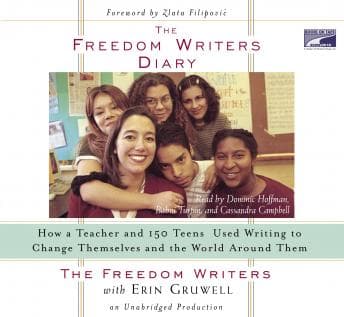

People keep telling me this is an "inspirational" book. And yeah, it is. But that word sells it short in a way that bugs me, like calling Fallujah "eventful." I finished this one on a late Tuesday night, sitting on the back porch with Ranger while Linda was asleep. I'd started it during a drive to a client site in San Antonio, figured it'd be decent background. By hour three I'd pulled over twice because I needed to actually sit with what I was hearing.
Let me cut to the chase: this book wrecked me in ways I wasn't expecting.
These Kids Ran Their Own Fallujah Every Day
Here's what got me. Erin Gruwell walks into Room 203 in Long Beach in 1994 - a first-year teacher, fresh-faced, probably wearing something from Ann Taylor - and faces a room full of kids who'd already survived more combat than some soldiers I've served with. Gang territory. Drive-bys. Friends dead before sixteen. And the school system had basically written them off as casualties before the fight even started.
The diary format is what makes this work as an audiobook specifically. You're not getting one narrator droning through 400 pages. You're getting entry after entry from different students - raw, unpolished, angry, scared, sometimes barely literate - and each one lands like a round hitting plate steel. One kid writes about sleeping in the bathtub because bullets come through the walls. Another talks about watching a friend get shot and then having to sit through algebra the next morning. These aren't abstractions. These are after-action reports from teenagers.
What Gruwell did - connecting the Holocaust to their daily reality, using Anne Frank's diary as a bridge - that's the kind of lateral thinking I wish I'd seen more of from officers. She identified the problem (kids who felt invisible and expendable), found common ground (history's worst examples of what happens when people are treated as less than human), and built a mission around it. Classic leadership. Plato was working a similar angle in Allegory of the Cave — the idea that someone has to care enough to turn people toward the light, even when those people have only ever known the wall. Didn't matter that she was a 23-year-old English teacher instead of a battalion commander.
Three Narrators, 150 Voices - Does It Work?
Bahni Turpin, Cassandra Campbell, and Dominic Hoffman split duties here, and you've got three AudioFile award winners passing the ball between them. Turpin carries a lot of the student diary entries, and she does something smart - she doesn't try to sound like a teenager. She reads with the weight of what these kids are carrying, not with some affected youthful voice. When a student writes about choosing between gang loyalty and staying alive, Turpin delivers it flat and matter-of-fact, which is exactly how a kid who's been through that would talk about it. No drama. Just truth.
Hoffman handles some of the connective tissue and does it clean. Campbell brings warmth without going soft. The three-narrator approach works because this book is fundamentally about many voices becoming one story. Single narrator would've flattened it.
I will say - and this is where the limited research on this audiobook frustrates me - I wanted more differentiation between the individual student entries. After a while, some blur together, and you lose track of which student is which. The book identifies them by numbers (Student 1, Student 2, etc.) rather than names for privacy, and in print that's fine, but in audio it can get disorienting. Not a dealbreaker. Just something I noticed around hour five.
The Part Where the Old Colonel Gets Uncomfortable
I've spent 25 years in an institution that takes broken things and tries to make them functional. The Army does this with varying success. What Gruwell did was take 150 kids the system had discarded and say, "Your story matters. Write it down." And they did. And it changed them.
The twentieth-anniversary additions hit hard - updates on where these students ended up. College graduates. Teachers themselves. Parents raising kids who aren't growing up in war zones. I've seen too many promising young soldiers come home and fall apart because nobody gave them the tools to process what happened. These kids got those tools at fifteen, sixteen years old. A composition notebook and someone who gave a damn.
(I'm not going to pretend my eyes didn't get wet during the section where students visit the Holocaust Museum. Ranger looked at me weird. We don't need to discuss it further.)
At 9 hours and 34 minutes, it doesn't overstay its welcome. I listened at my usual 1.25x and it felt right - the diary entries are short enough that you're constantly moving forward.
Who Needs to Hear This
Anyone who works with young people. Anyone who's ever been told a situation is hopeless. Anyone who thinks leadership only happens in boardrooms or battlefields. Skip it if you need explosions every chapter - Linda would have a field day with me recommending a book about a California English class. But the fight in this book is real. Different weapons, same stakes.
Worth your time? Here's the debrief: it's not a military book, not a thriller, not my usual lane at all. But good leadership is good leadership. And courage looks the same whether you're clearing a building in Kandahar or walking into a classroom full of kids who've already decided you're the enemy.
Ranger approved this one. So did I.








![Steve Jobs [unabridged audiobook] audiobook cover](/_next/image?url=https%3A%2F%2Fcovers.audiobooks.com%2Fimages%2Fcovers%2Ffull%2F9788499923406.jpg&w=1920&q=75)