
What happens when a book finds you at exactly the wrong moment - or maybe the exact right one?
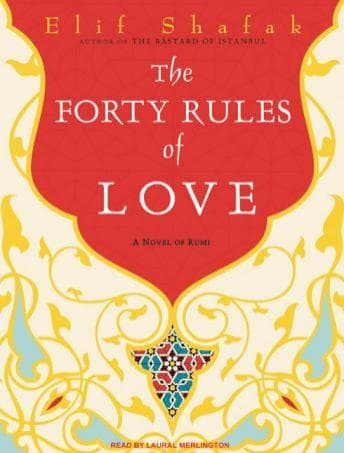
I was up past midnight finishing a client's branding project, running on cold coffee and the kind of creative emptiness that hits when you've been staring at hex codes for ten hours straight. Diego was asleep on my keyboard (again), and I had Forty Rules of Love playing through my studio headphones, and somewhere around hour seven I just... stopped working. Closed Illustrator. Sat in the dark with my cats and let Shams of Tabriz wreck me.
The Book That's Actually Two Books Wrestling Each Other
So here's the thing Elif Shafak does that I both love and have complicated feelings about: she gives us Ella Rubenstein, a dissatisfied suburban housewife in her forties reading a manuscript about Rumi and Shams, and then she gives us THAT manuscript - the thirteenth-century story of a wandering dervish who shows up and turns a respected cleric's entire life inside out. And these two narratives are not equal. They're just not.
The Rumi-Shams storyline? My heart. MY HEART. Shams arriving in Baghdad, testing people with his impossible questions, the slow transformation of Rumi from someone who had all the answers into someone brave enough to have none - that's where the book breathes and burns. Each of the forty rules drops into the story like a stone into still water. Rule 6 hit me so hard I paused the audiobook and just sat there: the idea that whatever happens in your life, no matter how crushing, was meant to happen, and what you call "setbacks" are really doors. Abuela used to say something similar when things fell apart. "Dios sabe, mija." God knows.
But Ella's contemporary story? It felt like reading someone's draft next to someone else's finished painting. Her unhappy marriage, her email flirtation with the mysterious author Aziz Zahara - it's all a bit too neat, a bit too obviously parallel. The metaphor announces itself instead of letting you discover it. I wanted to love Ella the way I loved Shams, but she reads more like a vehicle for the themes than a fully breathing person.
Laural Merlington in the Space Between Languages
This book felt like being read a bedtime story by someone who genuinely wanted to change how you see the world. Laural Merlington's voice has this warm, unhurried quality that works beautifully for the reflective pacing - she lets the mystical passages land without rushing to the next plot beat, which at 1.0x speed means you really sit inside each rule, each lesson.
Her vocal shifts between the contemporary and historical sections are smart. Ella gets this measured, slightly restrained American tone - controlled, a little repressed, which tracks. When she moves into Shams' voice, there's more heat, more edge, a rougher texture. It's not a full accent performance, but the energy changes enough that you feel the century gap.
Now - the Arabic and Turkish pronunciations. Yeah. Some of them are rough. "Shams" gets flattened in ways that made me wince, and certain Sufi terminology sounds like it's being read phonetically off a page rather than spoken by someone who's heard these words in context. For a book so deeply rooted in Islamic mysticism, that matters. It doesn't ruin the experience, but it creates small moments where you're pulled out of thirteenth-century Konya and reminded you're listening to an American production. I wish someone had coached her on those specific words - it would've elevated the whole thing.
When a Book Makes You Call Your Mom at 1 AM
I ugly-cried at the section where Shams talks about how love is not something you find in another person but something you become. And then again near the end - I won't spoil it, but the way loss and love get tangled together in the final hours felt so personal I had to pause and text my mom. Just "te quiero." She texted back a heart emoji and probably went back to sleep, but I needed to send it.
Abuela would have loved this one. The mysticism, the devotion, the idea that God lives in the love between people and not in the walls of any particular building - she wouldn't have agreed with all of it (she was church-every-Sunday Catholic till the end), but she would've understood it in her bones. She always said the rosary was just a way to hold love in your hands.
This is a rainy Sunday book. It wants your full attention, your willingness to sit with ideas that don't resolve into simple answers. The pacing is slow and deliberate - almost meditative - which will frustrate anyone looking for plot momentum. But if you're willing to let it wash over you, the cumulative effect is something close to spiritual.
Who Gets to Love This (And Who Won't)
If you want a fast-moving historical epic, this isn't it. If mispronounced Arabic will genuinely pull you out, be warned. I hit a similar wall with At the Water's Edge, where the atmospheric setting kept pulling me in while the central relationship left me wanting more substance to hold onto. If you need your contemporary storylines to be as strong as your historical ones, you'll feel the imbalance.
But if you've ever felt spiritually homeless - caught between traditions, between languages, between who you were raised to be and who you're becoming - Shafak wrote the Shams chapters for you. And Merlington delivers them with enough tenderness to crack you open.
The Rule I'm Keeping
Four stars - would be higher if Ella's storyline matched the depth of Rumi's, and if the pronunciation had been given more care. But the thirteenth-century half of this book is a love letter to seeking, to doubt, to the kind of love that requires you to lose everything safe. I'm going to carry Rule 6 around in my chest for a while.