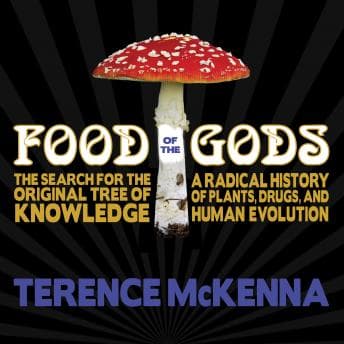

What if the missing link in human evolution wasn't a bone or a tool, but a mushroom?
I know, I know. Sounds like something my students would pitch as an excuse for a late essay. But here's the thing - Terence McKenna makes you actually consider it. And that's either the mark of a brilliant thinker or a very persuasive one. Possibly both.
I finished this during a week of particularly brutal faculty meetings. Principal Martinez was discussing budget allocations while I was learning about psilocybin's potential role in developing human consciousness. (Sorry, Principal Martinez. The mushrooms won.)
When Ethnobotany Meets Philosophy
McKenna's "Stoned Ape Theory" is exactly the kind of intellectual provocation I live for. The basic premise: our primate ancestors stumbled onto psilocybin mushrooms on the African savannas, and these psychedelics fundamentally rewired our brains - enhancing visual acuity, sexual arousal, and eventually language itself. It's wild. It's speculative. And McKenna presents it with the conviction of someone who's spent decades thinking about this stuff.
This reminds me of what Hemingway said about writing - you need to know your subject deeply enough that you can leave things out. McKenna clearly knows his subject. Whether you buy his conclusions is another matter entirely. Talking to Strangers operates in a similar space—taking a bold thesis about human behavior and running with it, evidence be damned.
The book sprawls across anthropology, botany, chemistry, and cultural history. He traces humanity's relationship with psychoactive plants from prehistoric mushroom rituals to the War on Drugs. McKenna writes like a man possessed, equal parts academic and mystic. My students would hate this. I love it.
But let's be real for a second. The scientific community has largely dismissed the Stoned Ape hypothesis. The evidence is circumstantial at best. McKenna himself was more philosopher than scientist, and the book leans heavily on speculation dressed up in scholarly language. You need to come in knowing that.
Jeffrey Kafer's Steady Hand
Here's where it gets interesting. Jeffrey Kafer's narration is... divisive. And I mean that as a genuine observation, not a cop-out.
His voice is deep and authoritative - the kind of voice that makes even the most out-there theories sound like they belong in a university lecture hall. There's a reason some listeners say his delivery "lends legitimacy" to McKenna's ideas. He maintains this steady, matter-of-fact rhythm through nearly nine hours of dense material. No small feat.
But - and this is a significant but - some listeners find him robotic. Nasal. Too clinical for material that's essentially about the ecstatic, the transcendent, the boundaries of human experience. I can see it. Kafer reads McKenna the way you'd read a textbook, not the way you'd read poetry. And McKenna's prose often veers toward the poetic.
I found myself wishing for more variation. More moments where the narrator let the wonder of McKenna's ideas come through in his voice. The content is already controversial enough - a warmer delivery might have made the medicine go down easier.
That said, for commutes and long walks, Kafer's consistency is actually a strength. I never lost the thread, even when McKenna dove into jargon-heavy sections about synesthesia and glossolalia. The pacing kept me engaged through the lakefront trail and back.
Who's Going to Love This (And Who Should Skip It)
If you want peer-reviewed science, this ain't it. If you're sensitive to nasal voices or prefer your narrators with more dramatic range, sample first. But if you're the kind of person who reads about psychedelic history on your lunch break (guilty), or if you've ever wondered why humans developed consciousness in the first place, McKenna offers a genuinely fascinating - if unprovable - answer. He's essentially asking: what if our entire civilization is the result of a 12,000-year withdrawal from a plant-based sacrament?
It's the kind of question that keeps you up at night. Or at least keeps you distracted during budget presentations.
The production is clean, no technical issues. At 1.0x, the pacing felt right for the material - though I could see bumping to 1.25x if Kafer's delivery feels too measured for you.
Class Dismissed
As someone who teaches the classics, I appreciate when a writer swings for the fences, even if they miss. McKenna swings hard. Whether he connects is up to you.