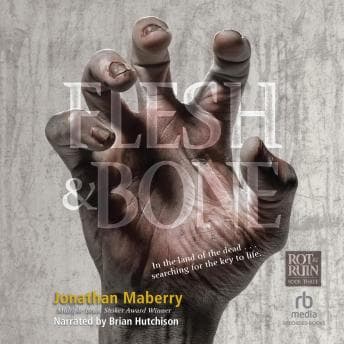

Can we talk about cliffhanger endings for a second? Because I have feelings. Strong ones. The kind that made me pause mid-stir of my dal makhani and actually say "wait, WHAT?" to my empty kitchen like a person who's lost all social graces. Flesh & Bone just... stops. Right when things get interesting. Right when the overarching mystery about that jet and humanity's survival finally starts moving forward. Nearly eleven hours of investment, and Maberry essentially says "tune in next time!" My therapist would have thoughts about my reaction to this. Something about attachment and unresolved narratives.
But I'm getting ahead of myself.
The Curious Case of Action Overload
Here's what's frustrating: I genuinely loved the first two books in this series. Maberry understands how trauma bonds people together while simultaneously creating fault lines that threaten to tear them apart. Benny, Nix, Lilah, and Chong aren't just zombie-slaying teenagers—they're a case study in survivor psychology. The way Maberry maps grief onto group dynamics actually reminded me of something Brené Brown unpacks in Atlas of the Heart—the distinction between how trauma isolates versus how shared survival can paradoxically deepen attachment. Benny exhibits classic guilt patterns, the kind I've written about in papers nobody reads. Watching him navigate that internal landscape while literally running from hordes of the undead? Psychologically, this tracks.
But this third installment tips hard toward action. Like, relentlessly. By hour seven, I'd lost count of the major fight sequences. There's a death cult subplot that's genuinely fascinating from a psychological perspective—cults emerging in post-apocalyptic settings, the way people construct meaning systems when the old world dies—but it doesn't get room to breathe. The evolution of the zombies (faster, smarter, more dangerous) raises questions the book refuses to answer. Setup for future books, sure. But it left me wanting the deeper character work that made me fall for this series in the first place.
Some listeners found themselves bored despite all the action, which sounds paradoxical but makes perfect sense. Action without emotional stakes becomes noise. And while the stakes are technically life-and-death, the pacing doesn't let you feel the weight of it.
Hutchison Keeps You Grounded
Brian Hutchison narrates, and the man is an Earphones Award winner for good reason. His approach is understated—he relies on subtle tonal shifts rather than dramatic accent work, which actually serves this material well. In a book where kids are constantly facing death, a narrator who pushed too hard would become exhausting. Hutchison trusts the material and trusts the listener.
What I appreciate most is how easy he makes it to follow the chaos. Multiple characters, constant action, shifting locations—and yet I never lost track of who was speaking or where we were. That's craft. The storytelling flows in a way that let me multitask (stirring, chopping, pretending my research papers would write themselves) without missing crucial plot points.
The Third Book Problem
This is a fascinating case study in series pacing. The first book establishes the world and characters. The second raises the stakes. The third... should pay off some of those investments, right? Instead, Flesh & Bone feels like an extended middle chapter. The journey through the wilderness is compelling in stretches, but the abrupt ending undermines the emotional work the book does manage to accomplish.
I found myself asking: why does this pattern happen so often in trilogies-that-aren't-really-trilogies? Maberry's clearly playing a long game—there are more books after this. But for listeners who just invested nearly eleven hours, the lack of resolution stings. You're not getting a complete story. You're getting a chapter of a larger story, and that's a different contract with the reader.
Who This Works For (And Who Should Skip)
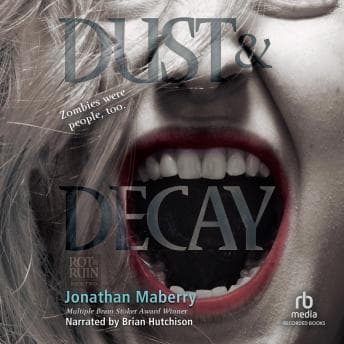
If you've already listened to Rot & Ruin and Dust & Decay, you're probably going to continue regardless of what I say. And honestly? You should. The series is worth finishing, and Lilah's arc alone—the feral girl slowly learning to trust—justifies the time investment. That same slow-burn character rebuild is what made Dust & Decay the strongest entry in the series for me—Hutchison's narration there hits a different emotional register when the stakes feel more personal. Just manage your expectations about pacing and resolution.
New to the series? Start at the beginning. Seriously. You'll miss crucial character development if you jump in here, and the emotional payoffs won't land.
Parents wondering about the "Kids & Family" categorization: there's significant violence and genuinely dark themes here. Know your kid. The content warnings for violence and zombie horror aren't exaggerated.
Diagnosis: Promising But Incomplete
Maberry is a Bram Stoker Award winner multiple times over, and his craft shows even when the pacing wobbles. The wilderness setting is genuinely threatening—fierce animals, death cults, and those evolved zombies create an atmosphere of constant danger. And Hutchison makes the journey worthwhile even when the destination feels incomplete.
I finished the audiobook while eating my dal makhani alone (don't feel sorry for me, I prefer it). And despite my complaints about the cliffhanger, I immediately added the next book to my queue. That's either proof of the series' grip on me or evidence of my own completionist pathology.
Probably both. Definitely both.