
ROI on Feelings? Surprisingly High.
Look, I bought this book because Jenny told me my emotional range is currently operating somewhere between "Spreadsheet Error" and "Q4 Revenue Target." She said I needed vocabulary. I told her I have vocabulary—I know what EBITDA is. She didn't laugh.
So there I was, stuck in gridlock on the 405, listening to a researcher talk about feelings at 2.0x speed. I expected to hate it. I expected fluffy, "live laugh love" nonsense that I'd have to refund after chapter three.
I didn't refund it.
The "Soft Skills" Are Actually Just Data
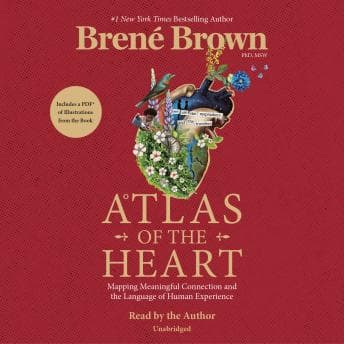
Here's the thing about Brené Brown—she's a researcher. She likes data. And Atlas of the Heart is basically a taxonomy of human emotion. As an ex-McKinsey guy, I respect a good framework. I love a MECE (Mutually Exclusive Collectively Exhaustive) breakdown.
Brown takes 87 emotions and defines them with the precision of a legal contract. She explains the difference between "envy" and "jealousy" (I was using them wrong), or "stressed" and "overwhelmed."
Why does this matter? Last week, a founder I'm coaching was spiraling. Before this book, I would've just told him to "toughen up" or "focus on the KPIs." Instead, I realized he wasn't "anxious"—he was experiencing "dread." Different problem. Different solution.
Bottom line: This isn't self-help fluff. It's a dictionary for human interaction. If you manage people, you need this. It's an efficiency tool for communication. (Don't tell Jenny I called it an efficiency tool. She'll make me sleep on the couch.)
The Author-Narrated Gamble
Usually, authors narrating their own books is a coin toss. Sometimes you get Neil Gaiman, sometimes you get a guy mumbling into a laptop mic in his basement.
Brené falls into the "Conversational Gold" category. It doesn't sound like she's reading a script. She nails this same conversational tone in Dare to Lead, though I'll admit that one felt more boardroom-focused. Here, it sounds like she's sitting in the passenger seat, drinking a coffee, and explaining why you're messed up.
She goes off-script. She adds sidebars. She laughs at her own jokes. At one point, she pauses to tell a story that isn't even in the printed book. That's value-add. That's exclusive content. I like that.
The catch (and this is a big one for my fellow efficiency nerds): She uses filler words. A lot. Decent amount of "likes" and "ums." At 1.0x speed, this might drive me crazy. At 2.0x, it just sounded like a fast conversation. But if you're the type who gets twitchy when a presenter isn't perfectly polished, you've been warned. It's raw. It's Texas casual.
The "Atlas" Problem
Here's the logistical snag: The book is called Atlas. It's visual. It's full of maps.
Trying to consume a visual map via audio while dodging a Tesla on the freeway is... interesting. She references a PDF a lot. "Look at the PDF," she says.
Brené, I am driving. I am not looking at a PDF.
To her credit, she describes the concepts well enough that you don't strictly need the visuals, but you can tell you're missing a dimension. It's like listening to a description of a PowerPoint deck. A really good deck, but still. I ended up downloading the PDF later to glance at it, which breaks my "audio-only" rule.
The Verdict
Is it worth 8.5 hours of your life? Yes.
It's cheaper than therapy and more actionable than an MBA leadership seminar. I've already used three concepts from this book in client meetings. It de-escalated a boardroom fight yesterday because I could accurately label the emotion in the room. Braving the Wilderness gave me similar practical tools, though that one's more about organizational culture than emotional vocabulary.
Who should listen: Managers, founders, anyone who's been told they have the emotional intelligence of a quarterly report. Who should skip: If you need a perfectly polished narrator or can't tolerate "um" at any speed, this'll frustrate you.
That's ROI, baby.
(Jenny says I'm missing the point of the book. She's probably right. But the client paid the invoice, so I'm counting it as a win.)