
Debugging Your Brain After a System Failure
It's 6:45 AM. I'm on the Baby Bullet to Mountain View, wedged between a guy coding in Haskell and someone sleeping with their mouth open. I'm running on four hours of sleep because I broke the build last night—like, really broke it. The kind of broke where you get paged at 2 AM.
Usually, this is when I'd blast The Bobiverse to escape reality. But honestly? I felt like garbage. I needed a patch for my own brain.
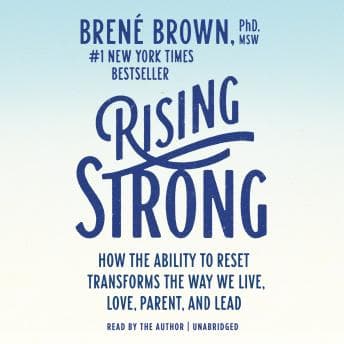
So I queued up Rising Strong. Kevin (my boyfriend) bet me I couldn't finish a "feelings book" without rolling my eyes.
Joke's on him. I didn't roll my eyes once. Okay, maybe once. But mostly, I was just nodding along like a bobblehead.
The "Root Cause Analysis" of Emotions
Here's the thing about Brené Brown. She's a researcher. She deals in data. She's basically an engineer for the human soul.
Most self-help books are just fluff—"believe in yourself!"—which is useless when your VP is asking why the site went down. Brown is different. She frames failure as a process. She calls it the "Reckoning, Rumble, and Revolution," but let's be real: it's just a debugging protocol.
- The Reckoning: Acknowledge the error log. (I feel like crap.)
- The Rumble: Dig into the code to find the bug. (Why do I feel like crap? Is it the code, or my impostor syndrome?)
- The Revolution: Push the fix to production.
Her concept of the "SFD" (Shitty First Draft) is literally how I write code. You write a messy version of the story in your head ("My boss hates me because I broke the build"), and then you refactor it with actual data.
(I may have actually paused the audiobook on the platform at Palo Alto to type "SFD: I am not a total fraud" into my Notes app. Don't tell my team.)
Author-Narrated (But Actually Good)
Normally, I have a strict rule: Unless you are Neil Gaiman, do not narrate your own book. Authors usually have the pacing of a sloth or the charisma of a damp towel.
Brené is the exception.
She sounds like that one senior engineer who mentors you over coffee—warm, urgent, no BS. She brings that same energy to Dare to Lead, though I liked this one better. It feels like a long podcast episode rather than a lecture. She doesn't have the dramatic range of Ray Porter (my spirit animal), but she has authenticity. When she talks about her own failures—and she shares some cringey ones—you believe her. That vulnerability runs even deeper in Braving the Wilderness, which I queued up right after this one.
One weird thing though: She lives in Texas. She talks about Texas. But where is the accent? It's totally neutral. Not a complaint, just... unexpected. I was ready for a "y'all" that never really came.
The Commute Test
Verdict: High ROI.
I listened at 1.5x speed. Brown speaks clearly and deliberately, so you can crank it up without losing comprehension.
It's perfect for the train because it's segmented into stories. If you zone out for 30 seconds because the conductor is shouting about ticket checks, you can jump back in easily. Not like hard sci-fi where missing one sentence means you've lost track of which timeline you're in.
However—and this is a big however—it's heavy. There were moments I had to switch to Spotify because I wasn't ready to "rumble" with my childhood trauma before my 9 AM stand-up.
Who Should (and Shouldn't) Listen
If you want a practical, data-backed framework for processing failure—whether that's a broken build, a broken relationship, or just the general brokenness of being human—this is your manual. Skip it if you're looking for light escapism or aren't in the headspace for some real self-examination.
Bottom Line
If you've ever face-planted—at work, in a relationship, or just existing as a human—this is the manual for getting back up. It's practical, data-driven, and devoid of toxic positivity.
It won't fix my code, but it definitely fixed my mood. Kevin owes me dinner.