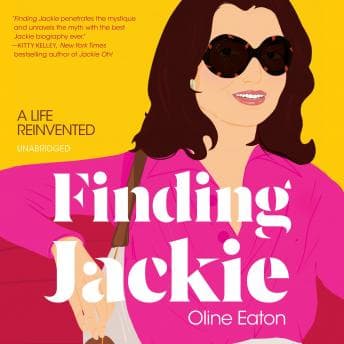

I was reorganizing my design files at 11 PM — you know, that thing you do when you're procrastinating on an actual deadline — when Jo Anna Perrin's voice stopped me mid-drag-and-drop. She was reading a passage about Jackie walking barefoot through Greece, braless, unrecognized, just existing outside the frame America had built for her. And I literally set down my stylus and sat with that for a second.
Because here's the thing: I thought I knew Jackie Kennedy. Telenovelas taught me dramatic women. Design school taught me iconography. And Jackie O is both — the pillbox hat, the sunglasses, the frozen composure at the funeral. That image is so locked into the American visual vocabulary that I'd never stopped to ask what came after the image.
Oline Eaton asks that question for eleven hours and never lets it get boring.
She Was Always More Than The Photograph
What Eaton does that genuinely surprised me is treat Jackie's post-assassination years not as a sad epilogue to Camelot but as the actual story. The Onassis marriage — which I'd absorbed through cultural osmosis as a scandal, a betrayal of the Kennedy myth — gets reframed as an act of self-preservation by a woman who'd watched one husband get shot and was terrified for her children. That reframe hit me somewhere unexpected. I thought about my abuela, who reinvented herself after my abuelo died, quietly and without anyone writing books about it. Women rebuilding themselves after catastrophic loss. The world calls it scandalous. I call it survival. I kept thinking about how Max Stirner's radical insistence on self-ownership in Ego and His Own cuts at something similar — the idea that reclaiming yourself from the identity others have assigned you is not betrayal, it's the most fundamental act there is.
Eaton's research is specific in ways that kept pulling me back. Not just the famous moments — the yacht, the pyramids — but the texture of Jackie's wandering. The braless-and-barefoot detail from the description isn't throwaway color; Eaton uses it to make an argument about how Jackie's body itself became a site of public ownership after Dallas, and how reclaiming it physically was part of reclaiming herself. That's the kind of analytical move that makes biography feel like it's actually about something.
The framing device — Jackie as an idea wired into America's emotional circuitry — could've felt academic and cold. It doesn't. Eaton writes with genuine affection for her subject without tipping into hagiography, which is a harder balance than it sounds.
Jo Anna Perrin Is Doing Something Specific Here
Okay. The narration. I've been burned by biography narrators who read like they're presenting a PowerPoint, and I was a little nervous going in because the research I found on Perrin was thin on specifics. What I can tell you from eleven hours of listening: she understands that this book has two registers — the historical-analytical passages and the more intimate, almost elegiac ones — and she shifts between them without making it feel like a gear change.
The analytical sections she reads with this crisp, forward momentum that keeps Eaton's arguments from feeling like lectures. But when the writing slows down — when Eaton is describing Jackie watching her children, or the specific quality of her grief — Perrin pulls back, lets the sentences breathe. There's a quietness she brings to those moments that felt genuinely respectful rather than performed. I didn't cry (this is Biography, not Beach Read, my spreadsheet has standards), but I did pause the audio twice just to sit with what I'd heard. That's Perrin's doing as much as Eaton's.
No audio issues, clean production, comfortable at 1.0x — which is the only speed, but you already knew that.
Who This Is For (And Who Should Probably Sit This One Out)
If you want a straight chronological biography of Jackie Kennedy's full life, this isn't that. Eaton is specifically interested in the reinvention years, the cultural erasure of that period, and what Jackie means as an idea. If that sounds like too much thesis for your biography, you might bounce off it.
But if you're someone who picks up books about women who refused to stay in the frame other people built for them? If you've ever watched a woman in your life quietly, stubbornly reconstruct herself after something devastating and thought someone should write that story? This one's for you.
Abuela would've had complicated feelings about this book — she had complicated feelings about Jackie marrying Onassis, I remember that much. But she would've listened to the whole thing. And then she would've had opinions.