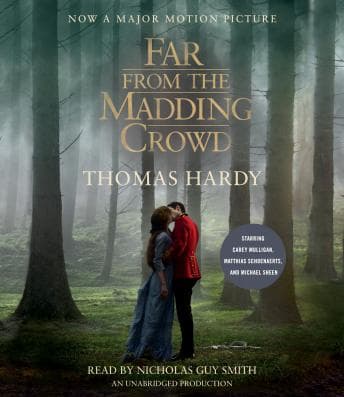

I was walking the lakefront with Denise last Sunday — one of those rare October mornings where Chicago pretends it's not about to betray you with winter — and somewhere around hour three of this audiobook, Bathsheba Everdene sent that valentine to Boldwood on a whim, and I actually stopped walking. Just stood there on the path like an idiot while joggers swerved around me. Because Hardy understood something about impulsive decisions that most novelists only gesture at: the way a small, almost playful act can detonate someone's entire life.
This is why we still read the classics.
Hardy's Sunniest Novel Is Still Plenty Dark
Let me be honest about something. I've taught Hardy for fifteen years, and I've always gravitated toward Tess and Jude the Obscure — the tragedies that hit like a freight train. Far from the Madding Crowd gets called his "sunniest" novel, and that's technically true, but it's sunny the way a beautiful afternoon is sunny right before a thunderstorm rolls in. Sergeant Troy's sword exercise scene — where he essentially seduces Bathsheba by nearly killing her with a blade — is one of the most uncomfortably erotic passages in Victorian literature. And Hardy wrote it without a single explicit word. My students would hate this. I love it.
What struck me on this listen, compared to reading it in grad school twenty-odd years ago, is how much this novel is about watching. Gabriel Oak watches Bathsheba constantly — from the opening chapter where he literally spies on her through a hedge gap, to his years of quiet, agonizing devotion. Boldwood watches her too, but his watching curdles into obsession. Troy doesn't watch at all; he performs. Hardy built an entire love quadrangle around different modes of attention, and hearing it unfold over fifteen hours made that architecture impossible to miss.
Nicholas Guy Smith Understands That Pause Is Punctuation
Smith's narration took about fifteen minutes to settle — and I'll be straight with you, those first fifteen minutes are a bit of a jumble. The rhythm feels uncertain, like he's finding his footing in Hardy's prose, which admittedly opens with some dense pastoral description that doesn't exactly scream "page-turner." But once he locks in? He's genuinely good.
What I appreciate most is his restraint. Hardy's dialogue shifts between educated speech and Wessex dialect — the farm workers speak in a completely different register than Bathsheba or Troy — and Smith handles this with subtle vocal shifts rather than cartoonish accents. His Boldwood carries this stiff, wounded formality that makes the character's unraveling later feel earned. His Troy has an ease, almost a laziness, that tells you everything about the man before the plot does. The narrator understands that in Hardy, class isn't just social — it's musical. Different people literally sound different, and Smith gets that.
At 15 hours and 18 minutes, this is a commitment. Hardy's descriptive passages about sheep-shearing and wheat harvesting and the rhythms of agrarian life are gorgeous but long. If you're comparing this to, say, a Dickens audiobook, Hardy gives you fewer plot twists per hour but far more landscape. Smith's pacing — those rises and falls in intonation, the hushed tones he drops into during the storm scene where Oak is desperately trying to save the wheat — kept me engaged through passages that, on the page, I'll admit I used to skim.
This is the thing about great narration: it's performance art. Smith isn't just reading Hardy. He's interpreting Hardy. And at 1.0x speed (yes, I'm that person), Hardy's prose deserves to be savored. The sentences have weight. They have cadence. Speeding them up would be like fast-forwarding through a cello concerto.
Who This Is Really For
If you loved Middlemarch on audio — and I did, during a particularly tedious stretch of faculty meetings — this is its spiritual successor in terms of tone and ambition. Both are long, both reward patience, both center on a woman navigating a world that wants to define her by who she marries. I found that same refusal to flatten a complicated woman in Good in Bed — different century, obviously, but Jennifer Weiner gives her protagonist that same messy, contradictory interior life that makes you want to shake her and root for her in the same breath. Bathsheba is stubborn and vain and brave and sometimes infuriatingly foolish, and Hardy lets her be all of those things without judgment.
If you need plot every five minutes, skip this. Seriously. Hardy will spend two chapters on a pastoral scene that exists purely to establish mood, and either that's your thing or it isn't. But if you're the kind of listener who wants to feel the dirt under your fingernails and smell the hay and understand why a shepherd would wait years for a woman who barely notices him — this is fifteen hours well spent.
Also: if you've only seen the Carey Mulligan film, the novel is richer and stranger and sadder than the movie had time to be. The movie is a beautiful sketch. The novel is the full painting.
Worth Pausing the Faculty Meeting For
I finished this on a Tuesday night while grading sophomore essays about The Great Gatsby. One of my students had written that Gatsby "loved Daisy too much." And I sat there thinking about Gabriel Oak — a man who loved someone too much but had the quiet grace to just... wait. Hardy and Fitzgerald are asking the same question from different centuries: what do we owe the people we love, and what does devotion cost us? I wanted to write that in the margins of the essay but figured a sixteen-year-old doesn't need a Hardy lecture at midnight.
Denise asked me what I was smiling about. I told her a shepherd finally got the girl. She said, "Good for him." She's right. Good for him.