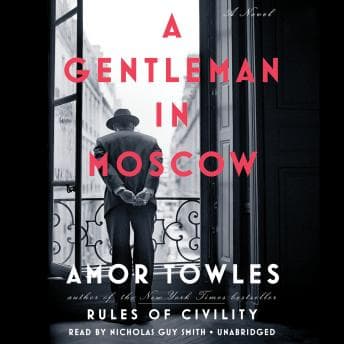

A Hotel Room Becomes the Whole World
I finished this one on a Sunday morning walk along the lakefront with Denise. We'd been listening together for the last few hours of the book - which is rare, because she usually taps out when I pick the audiobooks - and when it ended, we just kept walking in silence for a good five minutes. That's the thing about A Gentleman in Moscow. It sneaks up on you. You think you're listening to a charming little story about a Russian count stuck in a hotel, and then suddenly you're thinking about purpose and time and what it means to build a life within constraints you didn't choose.
Look, I'll be honest. When I first heard the premise - aristocrat under house arrest in a luxury hotel for thirty years - I thought it might feel claustrophobic. Eighteen hours is a long time to spend in one building. But Amor Towles does something I try to explain to my students all the time: he makes the container matter less than what fills it. The Metropol Hotel becomes its own universe. The count's attic room, the restaurant, the barbershop, the hidden passages - they expand and contract based on the richness of the relationships within them. This is why we still read the classics, honestly. Because the best writers understand that scope isn't about geography. It's about depth.
Nicholas Guy Smith Gets It
The narrator understands that pause is punctuation. I cannot stress this enough. Nicholas Guy Smith delivers this performance at exactly the pace Towles intended - the pace of a man who has learned that rushing gets you nowhere when you can't leave anyway. His Count Rostov is warm without being saccharine, witty without being smug. There's this particular quality he brings to the count's internal observations - a kind of bemused acceptance of absurdity - that had me actually laughing out loud during a faculty meeting. (Worth pausing Principal Martinez's curriculum update for. Sorry not sorry.)
What really impressed me was how Smith handles the supporting cast. We're talking decades of characters cycling through the count's life - a precocious girl who grows into a complicated woman, a temperamental chef, a one-eyed cat, various Soviet officials with varying degrees of menace. Each one gets their own voice without Smith ever descending into caricature. The chef's gruff affection. Nina's childhood curiosity sharpening into adult determination. These aren't just accents or vocal tricks. They're interpretations. He's making choices about who these people are and committing to them fully.
I listened at 1.0x, obviously. My students would hate this take, but the prose deserves to be savored. Towles writes sentences that reward attention - the kind where you catch yourself rewinding because you want to hear a particular turn of phrase again. Speeding this up would be like fast-forwarding through the meal scenes. And there are a lot of meal scenes. (They're wonderful. I was hungry for the entire second half of this book.)
The Slow Burn Question
Here's the thing I need to be honest about: this is not a plot-driven book. If you need things to happen in a conventional thriller sense, you might get restless. The first several hours are essentially the count adjusting to his new circumstances, meeting the hotel staff, establishing routines. Some listeners bounce off this. I get it.
But this reminds me of what Hemingway said about the iceberg theory - except Towles is doing something different. He's not hiding the weight beneath the surface. He's teaching you to see that the surface is the weight. The count's daily rituals, his friendships, his small acts of resistance and grace - these aren't filler before the exciting parts. They're the point. Tattooist of Auschwitz wrestles with similar questions about finding purpose under impossible constraints, though in far darker circumstances. The novel asks what constitutes a meaningful life when external markers of success and freedom have been stripped away. Pretty relevant question, if you ask me. (I teach teenagers. I think about purpose a lot.)
That said, the back half picks up momentum considerably. Without spoiling anything, the count's circumstances shift, stakes emerge, and there's a sequence near the end that had my heart genuinely pounding. Smith handles the tonal shift beautifully - the same measured voice that made you feel safe in the early chapters becomes almost unbearably tense when the situation demands it.
Who This Is Really For
If you loved The Remains of the Day, this is its spiritual successor. Same DNA of a life examined through the lens of service and restraint. Same quiet devastation when you realize what's been sacrificed. Same ultimate affirmation that small kindnesses accumulate into something larger than any single grand gesture. Lincoln Highway gave me that same feeling—Towles has this gift for making you care deeply about people living quiet lives with enormous dignity.
This is perfect for long commutes, for walks, for those nights when you're grading papers at 11 PM and need something that rewards partial attention but also rewards full attention. It's the rare audiobook that works whether you're focused or drifting. The episodic structure - jumping through years, landing on specific moments - means you can pause and return without losing the thread.
Who should skip it: If you need propulsive plotting or can't stand literary pacing, you'll bounce off the first few hours. My students would hate this - too slow, too concerned with ideas instead of action.
Who should listen: Anyone who believes a life well-lived is built from small moments, not grand gestures. Fans of character-driven historical fiction. People who want an audiobook that feels like good company.
I've already told three colleagues to listen to it, and I'm planning a podcast episode about it that my 47 listeners (hi, Mom) will probably sleep through. But that's fine. Some books are worth talking about even when no one's listening. Count Rostov would understand.