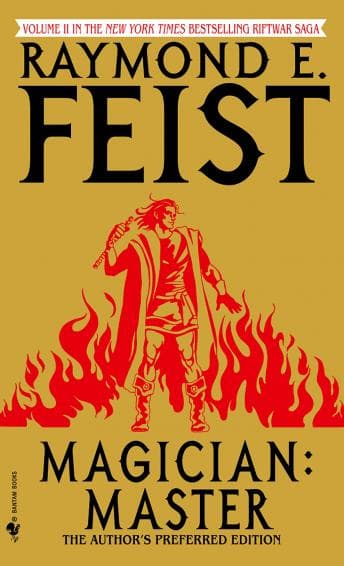

I was supposed to be working on my thesis. Instead, I'm sitting in my apartment at 2 AM, surrounded by board game boxes and unread academic papers, absolutely transfixed by Pug's transformation into Milamber. My advisor would be so disappointed. I am not.
Look, Feist's Riftwar Saga is basically required reading for anyone who grew up rolling d20s in the back of a library. And Magician: Master is where everything comes together - the magic system clicks, the world-building expands into something genuinely cosmic, and our boy Pug finally stops being a confused apprentice and starts being someone who could TPK an entire Tsurani army if he wanted to.
The Portal Fantasy We Needed Before Portal Fantasy Was Cool
This book does something I absolutely love: it takes the "fish out of water" trope and actually commits to it. Pug doesn't just visit Kelewan - he's enslaved there, stripped of everything, and has to rebuild himself from scratch. The Tsurani aren't just "evil invaders from another dimension." They have their own culture, their own magic system (which is chef's kiss), their own political intrigue. Feist was doing Sanderson-level world-building before Sanderson was out of elementary school. Ready Player One scratches a similar itch with its meticulously detailed virtual world, though Cline's nostalgia-fueled universe trades swords for Atari references.
The progression is satisfying in that old-school fantasy way where you actually earn your power-ups. When Pug finally embraces what he's become, there's this weight to it. My D&D group would lose their minds at the Great One magic system - it's got that perfect balance of mysterious and internally consistent that makes you want to take notes.
Nicholas Guy Smith: The Pronunciation Controversy
Okay, so here's where things get spicy. Nicholas Guy Smith has won an AudioFile Earphones Award, and you can hear why - his delivery is genuinely compelling. He gives the Tsurani this slightly alien cadence that sells the cultural divide. His emotional moments hit. When Pug is struggling with his identity, Smith makes you feel that conflict.
But.
The man apparently threw Feist's official pronunciation guide directly into a fire. And if you're someone who's read these books (like I have, multiple times, instead of writing my thesis), it will make you twitch. I kept hearing names and thinking "that's... that's not how that's supposed to sound." It's like if someone narrated Lord of the Rings and pronounced Gandalf as "GAN-dalf" with a hard G. Technically you can still follow the story. But part of your brain is screaming.
Some listeners find his style pretentious - there's this slightly theatrical quality that works great for the Tsurani court scenes but can feel a bit much during quieter moments. I didn't hate it, but I can see why some people bounce off. The pacing is also genuinely slow. I ended up bumping to 1.25x speed around hour six and never looked back. At 18+ hours, you need that momentum.
Who Should Roll Initiative (And Who Should Flee)
If you're a fantasy completionist who wants to understand where modern epic fantasy came from, this is essential. If you played D&D in the 80s or 90s, this is basically your childhood in audiobook form. If you love detailed magic systems and don't mind a slow burn that takes its time building to massive payoffs, you're in the right place.
Skip it if: pronunciation inconsistencies drive you up the wall, you need fast pacing to stay engaged, or you find theatrical narration grating. Also maybe skip if you haven't read Magician: Apprentice - this is definitely a "second half of the story" situation.
Worth Skipping My Thesis Deadline? Almost.
I really wanted to love this audiobook unreservedly. The source material is foundational fantasy - the kind of book that made me want to create worlds of my own. Smith's narration has genuine moments of brilliance, especially in the scenes where Pug discovers the full extent of his powers. There's this sense of destiny and ancient conflict that Smith sells beautifully.
But the pronunciation thing keeps nagging at me. It's like watching a great cover band play your favorite songs in slightly wrong keys. Still enjoyable. Still worth experiencing. Just... not quite right.
At 1.25x speed, this becomes a solid commute companion. Just maybe don't listen while you're supposed to be writing about procedural generation algorithms. Not that I would know anything about that.