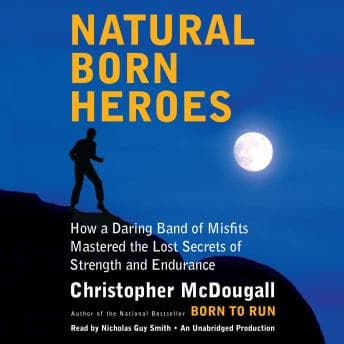

Fourteen hours into a drive from Austin to Phoenix for a client site assessment, and I'm learning how Greek partisans kidnapped a Nazi general using nothing but goat trails and sheer audacity. The irony wasn't lost on me—here I am in an air-conditioned truck with GPS, snacks, and satellite radio, while these guys humped a German officer across the White Mountains of Crete with the entire Wehrmacht hunting them.
Let me cut to the chase: McDougall's done it again. If you loved Born to Run, this is the same formula—crazy historical adventure wrapped in fitness philosophy—but with more tactical grit.
The Kind of Mission Brief I Actually Want to Read
The core story is the 1944 abduction of General Heinrich Kreipe by a ragtag team including Patrick Leigh Fermor (the "playboy poet" who'd walked across pre-war Europe), Billy Moss (a young SOE operative), and a network of Cretan shepherds who'd been resisting occupation since day one. McDougall doesn't just tell you what happened—he takes you into the mountains to understand *how* it was physically possible.
This is where it gets interesting for anyone who's actually operated in rough terrain. The book argues that modern fitness has it backwards. We train muscles in isolation, run on flat surfaces, eat processed garbage, and wonder why we can't perform when things get real. Think and Grow Rich preaches mental conditioning, but McDougall's arguing for something older—physical wisdom that comes from actually living in the terrain. The Cretan resistance fighters could move for days across terrain that would destroy most CrossFit athletes because they'd been doing it their whole lives. Natural movement. Functional strength. Food that actually fuels performance.
I've seen this play out in real life. The best operators I served with weren't always the gym rats. They were the guys who grew up hunting, climbing, working farms. Their bodies knew how to move.
Where McDougall Loses the Thread (Briefly)
Here's my complaint, and it's the same one I had with Born to Run: McDougall can't help himself. He'll be in the middle of a tense scene—the general's car approaching the ambush point, everyone in position—and suddenly we're on a tangent about fascia, or Brazilian capoeira, or some parkour instructor in London. The digressions are genuinely interesting, but the pacing suffers.
Some listeners found parts slow. I get it. If you're here purely for the WWII adventure, the fitness philosophy sections might test your patience. But if you're like me—someone who's spent decades thinking about what makes humans perform under pressure—those tangents are the whole point.
Nicholas Guy Smith Earns His Keep
The narrator's British accent works perfectly for material that involves SOE officers and Greek mythology in equal measure. Smith doesn't do wild character voices—this isn't a novel—but his pacing and intonation keep the historical sections moving and give weight to the philosophical bits. When McDougall describes Fermor and Moss waiting in the darkness for the general's car, Smith's delivery actually builds tension. That's not nothing.
I listened at my usual 1.25x and it felt right. Smith's clear enough that you don't lose anything, and the faster pace helps bridge those tangential sections.
The Homework Checks Out
McDougall traveled to Crete, retraced the actual route, interviewed surviving family members of the resistance fighters. The tactical details ring true—the way they established lookout positions, how they handled the general during the multi-day extraction, the logistics of feeding and hiding their prisoner. This isn't some armchair historian's fantasy. The mountains are real, the distances are real, and the physical demands are accurately portrayed.
What I appreciated most: McDougall doesn't romanticize the violence. The Cretan resistance paid an enormous price for their defiance. Entire villages were destroyed in reprisal. The book honors that sacrifice without turning it into action-movie entertainment.
Who's This Mission For?
If you're expecting a straight military history, you'll be frustrated by the fitness tangents. If you're expecting a fitness book, you'll be surprised by how much WWII you get. Skip it if you need tight, linear narrative structure. But if you're willing to let McDougall take you on his particular journey—part adventure, part philosophy, part challenge to everything you think you know about human performance—this is worth fourteen hours of your life.
Ranger slept through most of it, but he perked up during the mountain chase sequences. That dog knows good pacing when he hears it.
Mission accomplished. Not flawless, but the objective was achieved.