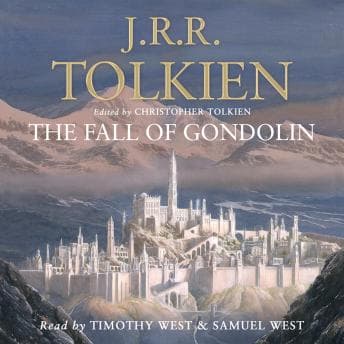

Look, I need to rant for a second. People out here giving this book two stars because it has editorial notes? In a Christopher Tolkien compilation? That's like walking into a trauma center and complaining there are sick people. You knew what this was.
Okay. Deep breath. Let me back up.
I picked this one up during a stretch of four night shifts in a row - the kind where by night three your brain is running on cafecito and spite. I wasn't reaching for Tolkien because I wanted light listening. I wanted something dense enough to keep my mind from going numb during 3 AM charting, something that would demand I pay attention. The Fall of Gondolin delivered on that front. Maybe too well.
A Father-Son Narration That Actually Works
Here's what I genuinely loved: Samuel West and Timothy West - actual father and son - splitting narration duties. Samuel handles the story proper, the mythic stuff, all those Elvish names that would make a lesser narrator's tongue cramp. The man says "Gondolin" and "Turgon" and "Ecthelion" like he's been speaking Quenya since birth. Timothy reads Christopher Tolkien's editorial commentary - the notes, the textual history, the "here's why this version differs from that version" sections. And the division is clean. You always know whether you're in the story or in the scholarly apparatus.
That said - and this is where the two-star crowd has a point, even if they're being dramatic about it - Timothy West's sections take up a LOT of real estate. We're talking maybe a third of this 8-hour audiobook devoted to Christopher Tolkien explaining his father's revision process, comparing manuscript versions, analyzing changes in character names. If you came here for the battle of Gondolin with Balrogs and dragons smashing through city gates? You're going to spend a significant chunk of your time in what amounts to a really well-narrated graduate seminar.
The Actual Fall (When You Finally Get There)
The attack on Gondolin itself? When Samuel West gets to those passages - the dragons crawling over the walls, the Balrogs with their whips of flame, Ecthelion's last stand - it's visceral in a way that makes Peter Jackson's battle sequences feel restrained. Tolkien wrote this story first, before almost anything else in his legendarium, and you can feel the raw energy of a young writer who'd survived the Somme pouring something primal onto the page. There's a passage where the city is burning and the Elves are fighting in the streets, house by house, and I actually stopped charting and just listened. In a trauma center. Where I should've been focused.
But here's my honest frustration: that intensity comes in waves, separated by long stretches of editorial scaffolding. You'll get twenty minutes of Tuor's journey guided by Ulmo, Lord of Waters - genuinely gorgeous, mythic storytelling - and then forty-five minutes of Christopher Tolkien walking you through three different versions of the same passage. It's academically fascinating if you're a Tolkien scholar. It's pacing poison if you're a tired night-shift nurse trying to stay engaged.
Who This Is Really For (Be Honest With Yourself)
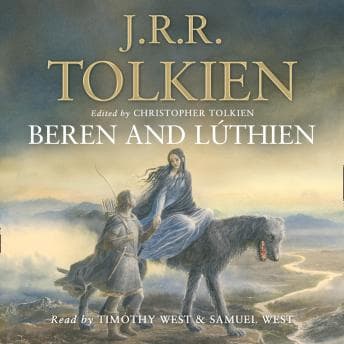
This is not The Hobbit. This is not even The Silmarillion with its continuous (if dense) narrative. This is a scholarly reconstruction presented as a reading experience. If you've read the other posthumous Tolkien releases - Beren and Lúthien, The Children of Húrin - and you loved the editorial framework, you'll be fine. Honestly, dense narrative layering done well is its own reward - I had a similar 'this demands your full attention or nothing' experience with Daniel Deronda, which is not a comparison I expected to make about a Victorian novel and a First Age myth-cycle, but here we are. If you want a straight story, you're going to be frustrated, and no amount of Samuel West's excellent delivery is going to fix that.
I landed somewhere in the middle. The story portions gave me chills. The editorial portions made my eyelids heavy at 4 AM, which is dangerous territory. Carlos asked why I looked so conflicted when I got home, and I tried to explain the textual history of the House of the Golden Flower and he just handed me coffee and walked away. Fair.
The narration itself is solid - Samuel West especially handles the elevated, archaic style without making it sound stiff or performative. He reads it like someone who believes in these words, not someone performing them. That matters with Tolkien.
Night Shift Prescription
If you're a Tolkien completist, this is worth your time. The Fall of Gondolin is one of the three great tales of the First Age, and hearing it performed by narrators who clearly respect the material is a genuine pleasure - in those moments when the material is actually the tale. Just know that you're signing up for the full academic experience, notes and all. Set your expectations accordingly, and you won't be disappointed.
If you just want the battle? Read the relevant chapter in The Silmarillion. I won't judge. Much.