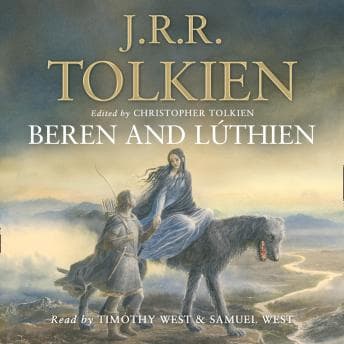

Everyone told me this was THE Tolkien love story. The one that inspired Aragorn and Arwen. The tale so important that Tolkien had 'Lúthien' engraved on his wife's tombstone. So I queued it up expecting an epic romance to carry me through a particularly brutal week of on-call rotations.
What I got was... not that. Or rather, not just that.
This Is Basically a Git History, But for Middle-earth
Look, I debug distributed systems for a living. I understand the value of version control. But I wasn't prepared for Christopher Tolkien to essentially give me a git log --all of his father's creative process. You get the original 1917 version, then prose fragments, then chunks of "The Lay of Leithian" (an epic poem that Samuel West absolutely crushes, by the way), then editorial notes explaining why version 3.2 differs from version 2.7.
Fascinating if you're a Tolkien scholar. Disorienting if you're a sleepy engineer at 6:47 AM trying to follow a love story.
The thing is—and this took me about two commutes to accept—this isn't Children of Húrin. That book reads like a novel because Christopher Tolkien had enough material to stitch together a complete narrative. Beren and Lúthien is more like... archaeological exhibit. Here's the artifact. Here's how it changed. Here's what we think it meant.
The Wests Make It Worth the Dig
Timothy and Samuel West—actual father and son, which feels appropriate for a book edited by Tolkien's son about Tolkien's work—bring decades of British stage experience to this. And you can hear it.
Samuel West in particular does something remarkable with the epic poetry sections. "The Lay of Leithian" is written in rhyming couplets, which could sound absolutely ridiculous in the wrong hands. Instead, he finds these rhythms that make the heightened language feel natural. When Lúthien sings to put Morgoth to sleep, there's this quality to his delivery that's almost hypnotic. That same mythic intensity shows up in Bridge of Realms, though with less poetry and more portal-jumping. I actually missed my stop once. (Kevin had to pick me up from Sunnyvale. He was not thrilled.)
The father-son dynamic works well for the dual nature of the book too—you've got the mythic, timeless quality for the actual tale, and then a more grounded delivery for Christopher's editorial commentary. Clear differentiation. No confusion about who's speaking.
The ROI Calculation Gets Complicated
Here's my honest assessment: at 6 hours 54 minutes, this is a moderate time investment. But the return depends entirely on what you're looking for.
If you want: A complete, flowing narrative you can follow while half-conscious on public transit → Skip this. Get Children of Húrin instead. Seriously.
If you want: To understand how Tolkien's creative mind worked, to see a story evolve from WWI-era mythology to the foundation of everything in Middle-earth → This is actually incredible. You can trace themes developing, see him experimenting with verse versus prose, watch the world-building crystallize around this central love story. It's like having access to a master class. Wolf Hunters doesn't have nearly this level of craft behind it, but it does share the whole 'facing down supernatural beasts' energy.
If you want: The love story itself, and you're patient → It's in here. Buried under layers of editorial apparatus, but it's in here. And when you hit those sections where Beren and Lúthien are actually doing things—stealing a Silmaril from Morgoth's crown, facing down the greatest werewolf in existence—it's genuinely epic.
The problem is you have to work for it. This isn't background listening. This is focus-required, probably-need-to-rewind-that-section listening.
Who's This For (And Who Should Bail)
Queue it up if: You've read The Silmarillion and wanted more. You're the type who reads director's commentary. You want to hear Samuel West nail rhyming couplets about immortal elves.
Skip it if: You want a straightforward fantasy romance. You need something for half-attentive commute listening. You haven't touched Tolkien's other work and this would be your entry point. (Start with the Peter Jackson films and work backward like a normal person.)
Final Debug Report
I finished this across maybe five or six commutes, and I'll be honest—I switched to 1.25x for some of the denser editorial sections. Not because the narration was slow, but because my brain needed the momentum to push through the academic bits.
The AudioFile Earphones Award makes sense. The production is clean, the performances are excellent, and for what this book is, the audio execution is spot-on. But what this book is might not be what you expect.
Would I listen again? Probably the Lay of Leithian sections, yeah. The editorial framework? Once was enough.
Tolkien wrote this story for his wife. That love comes through, even filtered through decades of revision and his son's careful curation. It's just... you have to dig for it.