
I was deep into a rebrand project at 2 AM, running on cold coffee and the kind of creative desperation that only hits when a client changes their "vision" for the fifth time. Frida was asleep on my keyboard. Diego was judging me from his perch on the bookshelf. And Dan Stevens was in my ears, walking me through the coal mines of Wales like he'd been born there.
This book wrecked me in ways I wasn't expecting.
When History Feels Like a Telenovela (Abuela Would Approve)
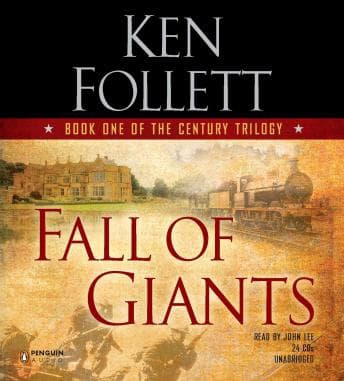
Look, I grew up on stories where passion collided with circumstance, where forbidden love meant something, where class divides weren't just plot devices but the air characters breathed. Fall of Giants gave me all of that—Lady Maud falling for a German spy while her brother represents everything she's fighting against? The housekeeper Ethel stepping above her station and paying for it in ways that made me pause my work and just... sit there? This is telenovela energy wrapped in historical legitimacy, and I mean that as the highest compliment. Testaments: The Sequel to The Handmaid's Tale gave me that same feeling—sweeping political stakes wrapped around intimate, devastating personal choices.
Ken Follett doesn't write small. Five families. Three countries. The First World War, the Russian Revolution, women's suffrage—he's juggling chainsaws while riding a unicycle, and somehow it mostly works. The Welsh mining family, the Russian orphan brothers taking radically different paths when revolution comes, the American finding his way into Wilson's White House. It's ambitious in a way that could easily collapse into chaos.
And sometimes? It does get unwieldy. After that gut-punch of an opening—Billy Williams descending into the mines at thirteen, the claustrophobia practically seeping through my earbuds—the middle sections occasionally lose that emotional urgency. The war details pile up. The political maneuvering multiplies. I found myself designing logos during passages that should have held me captive.
Dan Stevens Is Doing Something Supernatural Here
Okay, I need to talk about this man's voice.
I've listened to a lot of audiobooks. A lot. And Dan Stevens is doing something here that I've rarely encountered—he's making me care about characters across accents, genders, nationalities, and class divides without ever making me confused about who's speaking. His Welsh mining accent for Billy versus the aristocratic polish he gives the Fitzherberts creates this immediate, visceral understanding of the class divide that's central to the entire story. You feel it in your bones before Follett even explains it.
His female characters don't sound like a man doing a woman's voice (you know what I mean—that slightly condescending falsetto some narrators default to). Ethel sounds like a real woman navigating impossible circumstances. Lady Maud sounds like someone who's been raised with privilege but is sharp enough to question it. The Russian brothers—Grigori and Lev—have this slight difference in their cadence that tells you everything about their diverging paths before the plot does.
At nearly 13 hours, this is a commitment. But Stevens makes the time disappear.
The Emotional Passages Hit Different at 2 AM
I ugly-cried exactly twice. Once during a scene I won't spoil involving Ethel and the consequences of her choices. Under the Magnolias destroyed me more consistently—smaller canvas, but every emotional beat landed. Once during a war sequence that made me set down my stylus and just breathe.
But here's my honest take: those moments felt too sparse across such an epic canvas. Follett is so good at the sweeping historical detail, at the political machinations, at the interconnected web of families and fates—but sometimes I wanted him to slow down and let me feel more. The emotional passages that do land are devastating. I just wanted more of them.
This is a rainy Sunday book, but the kind where you need to be paying attention. It's not background listening. It demands focus, especially when you're tracking multiple storylines across continents. I tried listening while doing detail work on a logo and had to rewind three times. Save this one for when you can actually be present.
How It Stacks Against Pillars of the Earth
I listened to Pillars years ago—different narrator, different era, but the same Follett DNA. That one felt more intimate despite its length, more focused on a single community's story. Fall of Giants is trying to capture an entire world in transition, and that ambition is both its greatest strength and its occasional weakness. If Pillars was a love letter to one cathedral, this is a love letter to an entire century.
I'm not sure which I prefer. But I know I'll be starting the next book in this trilogy.
Who This Is (and Isn't) For
If you love sprawling historical sagas with forbidden romance and political upheaval—and you have the patience for a 13-hour commitment that demands your attention—this will sweep you away. Skip it if you need constant emotional intensity or prefer tighter, more intimate stories. The middle sections will test you.
Abuela Would Have Loved This
She would have gasped at Ethel's choices. She would have clutched her rosary during the Russian Revolution sequences and said "Ay, mija, the world was so cruel."
She would have been right.