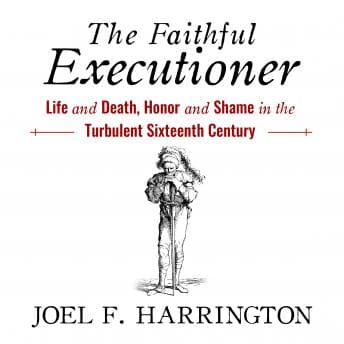

Meister Frantz Schmidt executed 394 people over forty-five years and kept a journal about it. Not a diary of his feelings—a professional log. And somehow, that clinical documentation becomes the most human thing I've listened to in months.
I started this one during a particularly brutal stretch of nights. Three codes in one shift, two we lost. Came home at 7 AM too wired to sleep, too tired to function. Put this on while I made breakfast for the kids and ended up standing at the stove, spatula in hand, completely still while Harrington walked me through how a sixteenth-century executioner learned his trade from his father. The parallels hit different when you've just spent twelve hours trying to keep people alive.
The Man Behind the Sword
Here's what got me: Schmidt wasn't born into this. His father was essentially conscripted into the executioner role, and that single act of violence—legal, state-sanctioned violence—marked the entire family as untouchable. Dishonorable. For generations. Schmidt spent his entire career not just doing his job, but trying to earn back the respectability his family never should have lost.
As someone who's actually worked a code, I understand compartmentalization. You have to. But Schmidt's journal reveals something more complicated than simple detachment. He notes when condemned prisoners showed courage. He records when he thinks someone was innocent. He petitioned—successfully—for mercy for some defendants. This isn't the portrait of a monster. This is a portrait of a man doing impossible work within an impossible system, trying to find meaning in it.
Harrington doesn't let him off the hook, though. The torture descriptions are clinical and awful. The medical details are accurate. Finally. (I've read too many historical novels where authors clearly Googled "medieval torture" and called it research.) Schmidt broke bones. He burned flesh. He did these things methodically, professionally, and then went home to his wife and children.
Night Shift Energy, 1573 Edition
James Gillies narrates with this measured British tone that some listeners apparently found odd for an American author writing about German history. I didn't care. His delivery has this slight ironic edge—not mocking, just... aware. Aware that he's describing a man who flogged people for a living and also worried about his daughter's marriage prospects. The contrast works.
The pacing suits focused listening. This isn't background material—you need to pay attention to catch the subtle ways Harrington connects Schmidt's personal struggles to the broader chaos of Reformation-era Europe. Religious conflict, class warfare, paranoia about witches and vagrants. Schmidt operated in a world where the line between criminal and victim was often determined by who had money and who didn't.
Sound familiar? I've watched patients get different treatment based on insurance status. I've seen who gets the benefit of the doubt and who doesn't. Schmidt's Nuremberg isn't as far away as we'd like to think.
Rabbit: The Autobiography of Ms. Pat cracked me open in exactly the same way—a person navigating brutal systems they didn't design, trying to hold onto dignity anyway, and somehow making you feel the full weight of how little has actually changed.The Unwed Mothers Made Me Pull Over
I need to warn you about the infanticide cases. Schmidt executed multiple women—young, poor, desperate women—for killing their newborns. He records these with the same professional detachment as the highway robbers and the murderers. But Harrington unpacks what's underneath: these were often servants, impregnated by employers who faced no consequences, facing certain social death if their pregnancy became known.
Carlos asked why I was crying in the car. I blamed allergies. I was actually thinking about a teenage patient I had years ago, scared out of her mind, no support system. Different century, same impossible choices.
Who This Is For (And Who Should Skip)
If you want a quick, easy listen about a quirky historical figure—this isn't it. At nearly ten hours, it demands attention. But if you're someone who thinks about systems—how they create roles, how people survive within them, how "just doing my job" becomes its own kind of moral negotiation—you'll find yourself thinking about Meister Frantz for weeks. Skip it if you're squeamish: the content warnings are real. Torture, execution, violence against women. Harrington doesn't sensationalize, but he doesn't look away either.
Clocking Out
I finished this one on my third consecutive night shift, charting at 4 AM while my patients slept. Schmidt worked nights too, in a way. Preparing for executions. Maintaining his tools. Writing in his journal by candlelight. Trying to make sense of a job that required him to hurt people in order to serve justice.
My mom would love this (she still thinks I should've been a doctor). She'd appreciate a man who took his work seriously, who tried to be good within a bad system, who never stopped hoping his children might live better than he did.
Four hundred years later, I get it.








![Steve Jobs [unabridged audiobook] audiobook cover](/_next/image?url=https%3A%2F%2Fcovers.audiobooks.com%2Fimages%2Fcovers%2Ffull%2F9788499923406.jpg&w=1920&q=75)