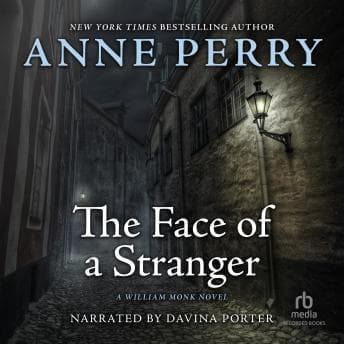

Everyone kept telling me this was a slow-burn Victorian mystery, and I went in bracing for draggy drawing room scenes and endless tea descriptions. Turns out they were half right - but the half they got wrong is what makes this book stick.
I finished my last shift of the week at 4 AM, came home, and instead of crashing immediately I sat in the driveway for twenty extra minutes because Monk was about to confront something ugly about himself and I needed to know. Carlos texted me asking if I was okay. I was not okay. I was in 1850s London watching a man terrified of his own reflection.
A Detective Who Can't Remember How to Be One
Here's what grabbed me: William Monk wakes up in a hospital bed with no memory. Not soap-opera amnesia where you conveniently forget your evil twin - real, disorienting, identity-erasing amnesia. And Anne Perry does something brilliant with it. She doesn't just use it as a plot device. She makes you feel the specific horror of discovering you might not like who you were before.
Monk goes back to work investigating the murder of a Crimean War hero, and he's basically faking his way through every interaction. Reading people's faces for clues about whether they expect him to be kind or cruel. Finding out through others' reactions that pre-amnesia Monk was apparently a real piece of work - ambitious, cutting, not exactly beloved by his colleagues. As someone who's actually worked with doctors who've had their reputations precede them, watching Monk navigate that gap between who he was and who he's becoming hit different.
The murder investigation itself moves at a deliberate pace. I'll be honest - there were stretches around hours 5 through 7 where I wished Perry would pick up the tempo. The Victorian social maneuvering is detailed and atmospheric, but sometimes I felt like I was waiting for the next revelation about Monk's past rather than caring about the actual case. The dead war hero, Joscelin Grey, stays pretty abstract for a long time. But when the pieces start clicking together toward the end - and that confession scene, helped along by a character you wouldn't expect - it lands.
Davina Porter Made Me Forget She's Not a Victorian Man
Okay, so here's where I was genuinely surprised. Female narrator, male protagonist, Victorian London setting - I expected it to feel off. It didn't. Davina Porter does this thing where she doesn't try to go deep and gravelly for Monk. Instead she captures his temperament - that careful, suspicious, slightly cold energy - through pacing and inflection rather than pitch tricks. It works way better than it should.
She slides between characters without signposting it, which means you have to actually listen. This is not a background-while-doing-dishes audiobook. I tried that once during this listen and had to rewind fifteen minutes. Porter differentiates characters through subtle shifts - the slightly warmer tone for Hester Latterly (the nurse character, and yes, I have opinions about how Perry writes nurses), the more clipped delivery for Monk's superior Runcorn. It's not dramatic voice acting. It's more like... emotional shading. And for a 13-hour mystery with a lot of conversation, that restraint is the right call.
The one thing I'll flag: if you're coming from Porter's work on the Charlotte and Thomas Pitt series, some listeners feel her Monk narration doesn't quite reach the same level. I haven't listened to those yet, so I came in fresh, and I thought she was excellent.
The Medicine and the History - A Nurse's Notes
Perry gets the hospital scenes mostly right for the era. The conditions Monk wakes up in, the way injuries were managed in the 1850s - it tracks. And Hester Latterly, who served as a nurse in the Crimean War alongside Florence Nightingale, is written with real respect for what nursing actually was back then. Not a doctor's handmaid. A professional working in horrific conditions with limited resources and unlimited demand. That same respect for professionals grinding through impossible circumstances shows up in Silent Woman, though the setting couldn't be more different. My mom would love this. (She still thinks I should've been a doctor, but she'd appreciate Hester.)
What Perry captures that most period mysteries don't bother with is the class structure of medical care. Who gets treated and how, who gets believed, whose pain matters. That hasn't changed as much as we'd like to think. At 3 AM in a trauma center, you see echoes of it.
Who Should Listen and Who Should Bail
If you need a fast-paced thriller with a body count, this isn't it. If you want a psychological puzzle wrapped in fog and gaslight, with a protagonist who's essentially investigating himself while pretending to investigate someone else - yeah. This is your book.
Perfect for that post-shift decompression when your brain is wired but your body is done. The pacing actually works in your favor there - it pulls you in without spiking your adrenaline. I'd recommend 1.25x speed if you're a faster listener, just to keep the middle sections from dragging.
Night Shift Approved - With a Caveat
I'm going to keep going with this series. That's the real verdict, right? When you finish a 13-hour book and immediately check if Book 2 is on your app. The amnesia hook is strong enough to carry through any slow patches, Porter's narration rewards your attention, and Perry writes the kind of historical detail that feels lived-in rather than researched. Cold Vengeance pulled me into that same lived-in headspace - different era, but that same sense that the author has actually walked the streets they're describing. Not perfect. But real enough to keep me in the driveway at 4 AM, texting Carlos back: "Fine. Just London. Be in soon."