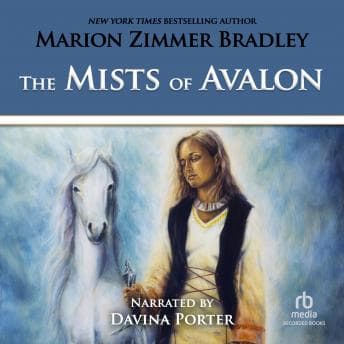

So I started this during a particularly brutal coding session - you know, the kind where you're debugging the same function for six hours and questioning every life choice that led you to grad school. Fifty-one hours later, I emerged from the mists myself, blinking like I'd just woken from some kind of fever dream. And honestly? I regret nothing. (Dr. Patel might disagree, but what's another week on the thesis timeline at this point?)
Look, I grew up on Arthurian legend. My D&D group ran a Camelot campaign for two years straight. I've read T.H. White, I've read Malory, I've listened to every adaptation I could get my hands on. But this? This is something else entirely.
The Women Who Actually Built Camelot
Here's the thing about most Arthurian retellings - the women exist to be rescued, seduced, or blamed for the fall of kingdoms. Marion Zimmer Bradley said "absolutely not" to all of that. Morgaine isn't some cackling villain. Viviane isn't just a mystical plot device. These are fully realized people with their own agendas, their own faith, their own complicated relationships with power and duty.
The magic system here - and yes, I'm using that term because that's what it is - feels genuinely pagan in a way most fantasy doesn't bother with. It's not flashy. It's not about fireballs and lightning bolts. It's about the Sight, about ritual, about the slow erosion of the old ways as Christianity spreads across Britain. As someone who's spent way too many hours building homebrew magic systems, I appreciated the internal consistency. The rules make sense. The costs are real. Wizard's First Rule takes a different approach to magic—more flashy, less ritualistic—but I appreciated the same attention to consequences and internal logic.
And the political intrigue? Chef's kiss. The tension between Avalon and the Christian church, the way Arthur gets pulled between two worlds - it's Sanderson-level world-building, just applied to a myth we all think we know.
Davina Porter Walked So Other Narrators Could Run
Okay, I need to talk about the narration because Davina Porter is doing something special here. Fifty-one hours. FIFTY-ONE. That's longer than the entire First Law trilogy. That's basically a full work week of audio. And she makes every hour count.
Each character has a distinct voice - not just an accent, but a whole personality that comes through in the delivery. Morgaine sounds different at fifteen than she does at forty. Viviane has this weight of authority that you can hear. Even the minor characters feel like real people. I found myself recognizing who was speaking before the dialogue tags caught up.
The pacing matches the story perfectly. This isn't an action-heavy book - if you need sword fights every chapter, you're gonna have a bad time. But Porter leans into the slow burn. She gives the emotional moments room to breathe. When the gut-punch scenes hit (and they hit), the narration doesn't rush past them.
The Commitment You're Signing Up For
I'm not gonna pretend this is for everyone. Fifty-one hours is a commitment. The story moves at the pace of seasons changing, of children growing, of religions slowly supplanting each other. There are stretches where not much "happens" in the traditional sense - but everything is happening beneath the surface.
If you're the kind of listener who needs constant plot momentum, you might struggle. If you listen while doing something that requires attention, you might miss the subtleties. This is a book that rewards focus. I found myself pausing my code editor just to really listen during key scenes. (Again, don't tell my advisor.)
The dialogue-heavy approach won't work for everyone either. This is character-driven storytelling at its most committed. The action, when it comes, matters precisely because we've spent so much time in these people's heads.
Roll for Recommendation
Honestly? I probably won't relisten immediately - I need to recover. But in a few years, when the thesis is done (stop laughing), when I want to lose myself in something epic again? Yeah. I'll come back to Avalon.
This is the kind of audiobook that changes how you think about a story you thought you knew. Every time someone at my D&D table plays a Morgana-inspired character now, I'm going to be thinking about this version. Every time someone mentions Arthur, I'll remember the boy caught between two worlds, trying to do right by both.
It's not perfect. The length is genuinely daunting. Some of the pacing in the middle books drags. But when it works - and it works more often than not - it's something special. My D&D group would absolutely love this, and I'm already planning to recommend it to the two of them who have long commutes. Skip this if you need action every chapter or can't commit to slow-burn storytelling. But if you love deep world-building, feminist retellings, and have fifty-one hours to spare? Clear your queue.
Just... maybe don't start it during a thesis crunch. Learn from my mistakes.