
So there I was at 2 AM, absolutely not working on my thesis chapter about procedural dungeon generation, when I realized I'd been listening to people get ripped apart by evolved Ebola monsters for the past six hours. My advisor would be so proud.
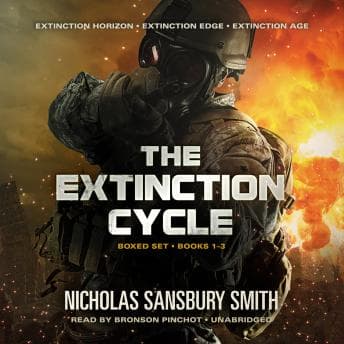
The Extinction Cycle boxed set grabbed me the way a good campaign hook grabs your D&D party—you know you're walking into a meat grinder, but the DM (in this case, Nicholas Sansbury Smith) has laid out just enough mystery that you can't help but take the bait.
When Your Monster Manual Gets a Horrifying Update
Look, I've consumed a lot of zombie-adjacent media. It's basically a requirement for anyone who's ever run a survival horror one-shot. But Smith does something clever here that kept my thesis-procrastinating brain engaged: the monsters evolve. Book one gives you hemorrhage virus victims—think fast zombies with extra body horror. Fine, standard fare. But by book two? The Variants have undergone epigenetic changes that make them genuine apex predators. They're not shambling corpses. They're hunting you.
This is Sanderson-level world-building applied to the apocalypse. There are rules. The virus behaves consistently. The military responds with actual tactics instead of movie-logic stupidity. Dr. Kate Lovato's bioweapon research follows a logical progression—she's not just pulling solutions out of nowhere. When her first cure creates an even worse problem in book two, it felt earned. Consequences! In my fiction! What a concept.
The progression scratches that same itch as good LitRPG—each book escalates the threat level while expanding what we understand about the Variants. By Extinction Age, you're watching humanity genuinely lose, and the desperation feels real because Smith built up to it properly.
Bronson Pinchot Walked So Other Military Thriller Narrators Could Run
Okay, I need to talk about the narration because Bronson Pinchot is doing work here. This is the guy who won Audible's Narrator of the Year, and you can hear why. Every character voice rings true—Master Sergeant Beckham sounds like a Delta operator should, all controlled tension and professional calm even when everything's going sideways. Kate Lovato gets a completely different register, scientific and increasingly desperate.
What really impressed me was how Pinchot handles the gory stuff. And there is a lot of gory stuff. Scenes that could easily become gratuitous shock content instead land with genuine horror because his pacing and delivery sell the reality of it. Having him narrate helped move some of the nastiest parts along without making me want to tap out. (Though maybe don't listen while eating. Learned that one the hard way around hour eight.)
Fair warning: apparently his French accent in later books gets some criticism. These first three don't have that issue, but if you continue the series, adjust expectations accordingly.
25 Hours of Apocalyptic Commitment
Yes, it's 25 hours and change for this boxed set, which is honestly perfect. You get a complete story arc across three books without the commitment of a full Stormlight novel. (Though let's be real, I'd still recommend those too.)
The pacing stays tight. Smith clearly has military thriller DNA—he doesn't waste time on filler. When Team Ghost goes into New York for Operation Liberty, you're getting action set pieces interspersed with genuine tension. The sewer escape sequence in book three had me pausing my code compilation just to focus on what was happening. My procedural generation algorithm can wait. Reed Beckham cannot.
If you don't like info-dumps, this isn't for you (but you're wrong). Smith includes enough military and scientific detail to make the world feel grounded without becoming a textbook. It scratches the same itch as a well-researched D&D supplement—you can tell the author did his homework.
Roll for Initiative (Or Just Hit Play)
My D&D group would love this. Actually, I'm already stealing the Variant evolution concept for a future campaign. Monsters that adapt to your tactics? Players who have to constantly adjust their strategies? Chef's kiss.
Who should grab this: Anyone who likes their apocalypse fiction with actual science, military competence, and monsters that feel genuinely threatening. If you enjoyed World War Z (the book, not the movie) or want something grittier than your average zombie fare, this delivers.
Who should skip: If you need deep character introspection or literary prose, this ain't it. Smith writes action-focused military thriller, and he does it well, but don't expect existential meditations on the human condition. For military sci-fi that does wrestle with deeper questions about consciousness and loyalty, Ghost Brigades pairs that same tactical competence with genuine philosophical weight. Also maybe skip if you're squeamish—the body horror is real.
I listened at 1.25x speed and Pinchot's performance held up perfectly. Might try 1.5x on a relisten, but his voice work deserves some breathing room.
Now if you'll excuse me, I have a thesis to definitely work on and absolutely not another six hours of Extinction Cycle to consume.