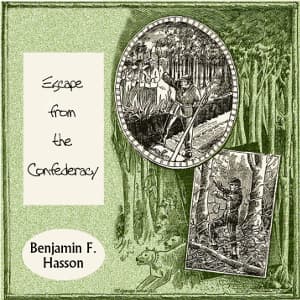

Ninety-four minutes. That's all it takes to get the full account of a Union officer jumping off a Confederate prison train headed for Andersonville and making his way back to friendly lines. I knocked this out during a late-night session cleaning my Beretta at the kitchen table - Ranger curled up at my feet, Linda already asleep - and it hit me that some of the best war stories don't need 20 hours to land.
Let me cut to the chase: this is a slim, honest first-person account from a man who knew that staying on that train meant a slow death at Andersonville. It's not polished. It's not dramatic. It's a soldier telling you what happened, and sometimes that's enough.
A Prison Train, A Dark Night, and Pure Nerve
Hasson's escape itself is the kind of thing that would get you laughed out of a Hollywood pitch meeting for being too simple - he gets off a moving train in the dark and just... starts walking. But that simplicity is what makes it real. I've seen this scenario play out in real life, or close enough to it. Escape and evasion isn't usually explosions and car chases. It's hunger, bad decisions at creek crossings, and praying the next farmhouse isn't hostile.
What surprised me - and this is where the book earned its keep - is how much time Hasson spends on the Black Southerners he encountered during his flight. Enslaved people who fed him, free Black men who pointed him in the right direction, all at enormous personal risk. He doesn't editorialize much about it, which honestly makes it more powerful. He just tells you what they did. In 1864, helping an escaped Union prisoner could get you killed, and these people did it anyway. That section alone makes the listen worthwhile. That kind of raw, unadorned truth-telling - where the facts carry more weight than any editorial flourish - is something I found equally striking in Twilight of the Idols, though the subject matter couldn't be more different.
David Wales Reads It Like a Deposition - And That's Mostly Fine
The author clearly did their homework. Well - the author lived it, which is better than homework. David Wales narrates this with the energy of a man reading a historical document into the record, which is basically what this is. His delivery is clean, clear, and about as emotionally charged as a weather briefing. For a 94-minute primary source account, that actually works. You're not here for vocal theatrics. You're here because a guy escaped a Confederate death sentence and wrote it down.
That said - and this is where it lost me a little - there are moments where Hasson describes genuine terror and Wales delivers them at the same flat register as the preceding paragraph about geography. When Hasson talks about the conditions he'd heard about at Andersonville, the dread should land harder. A slight shift in pacing or tone would've gone a long way. At this length, you don't need a full-cast production, but you do need the narrator to occasionally remind you that a man's life was on the line.
I bumped playback to 1.25x (my default) and it felt right. Wales isn't slow exactly, but the slight speed increase adds a sense of urgency the delivery otherwise lacks.
Who Should Fall In On This One
Worth your time? Here's the debrief: if you're a Civil War history buff, this is a quick, authentic primary source that you can consume in a single sitting. It's not trying to be Shelby Foote. It's one man's account, and its value is in the unvarnished specifics - the interactions with Southern civilians both Black and white, the practical details of moving through hostile territory, the psychological weight of knowing what Andersonville meant.
If you need action-packed pacing or a narrator who's going to give you different voices for every character, skip this. That's not what this is. This is a document. A good one, but a document.
Note: this version cuts the final section of Hasson's original book - a roster of captured men from his regiment and what happened to them. That's a loss. Those lists matter. Every name on there was somebody's son or brother, and stripping them out to save fifteen minutes feels like the wrong call.
Mission Brief: Short, Real, and Worth the Detour
For under two hours of your life, you get a genuine escape narrative from a man who was there, with an unexpectedly valuable window into how Black Southerners aided Union escapees at great personal cost. The narration is functional rather than inspired, but the source material carries its own weight. Ranger slept through it, but Ranger sleeps through everything that doesn't involve the word "walk." I stayed awake, and I'm glad I did.





![Steve Jobs [unabridged audiobook] audiobook cover](/_next/image?url=https%3A%2F%2Fcovers.audiobooks.com%2Fimages%2Fcovers%2Ffull%2F9788499923406.jpg&w=1920&q=75)