
"The only thing that makes sense is to strive for greater collective enlightenment."
That line hit me around the two-hour mark while I was supposed to be debugging my procedural terrain generator. Spoiler: I did not debug anything. I just sat there thinking about how Elon Musk was building rockets while I can't even get my thesis draft to Dr. Patel on time.
The Origin Story Arc We Didn't Know We Needed
Look, I'll be honest—I picked this up because I needed something lighter after a 47-hour Stormlight Archive reread, and a 6.5-hour biography seemed like a palette cleanser. What I got instead was basically a real-world progression fantasy. The same kind of underdog-to-legend arc powers Sergeant York and His People, though York's battlefield was considerably more literal. Musk's journey from getting beaten up in South African schools to launching reusable rockets? That's a character arc that would feel unrealistic in fiction.
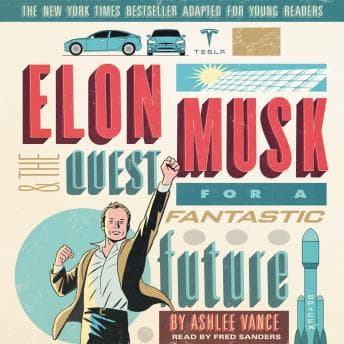
Ashlee Vance had direct access to Musk, his family, his ex-wives, his employees—the whole constellation of people who've orbited this guy. And the young readers' edition doesn't dumb things down so much as it strips away some of the business minutiae that adults apparently need. The result is actually tighter. You get the SpaceX near-bankruptcy moments, the Tesla production nightmares, the PayPal mafia drama, all without getting lost in quarterly earnings reports.
The progression is satisfying in that LitRPG way—Musk literally levels up from building video games as a kid to building actual spacecraft. Each company is like unlocking a new skill tree. PayPal was the tutorial level. Tesla was the first real boss fight. SpaceX is the endgame content.
Fred Sanders: Solid Support Class
Here's where I have to be real with you: Fred Sanders is competent. Solid. Gets out of the way and lets the material speak. But this isn't a Steven Pacey situation where the narrator elevates everything to art. Sanders reads the book well—good pacing, clear diction, doesn't stumble over the technical jargon. For a biography aimed at younger listeners, that's actually the right call. You don't want a narrator trying to do "voices" for Elon Musk quotes.
The production is clean. No weird audio artifacts or volume inconsistencies that I noticed. At 6.5 hours, it's the perfect length for a weekend of coding (or, you know, procrastinating on coding).
Where It Crits (And Where It Misses)
The book shines when it gets into the engineering challenges. How do you build a rocket that can land itself? How do you make an electric car that doesn't suck? These sections feel like reading about magic systems—there are rules, constraints, and then someone figures out how to break them in clever ways. My D&D group would love the problem-solving mentality on display here.
But—and this is a significant but—this is a biography written with Musk's cooperation, and you can feel it. The narrative doesn't shy away from his difficult personality (the book explicitly discusses how hard he is to work for), but it's definitely telling his story from his perspective. The workers who burned out? The relationships that imploded? They're mentioned, but we don't really sit with them.
For a young readers' edition, I get it. You're not writing a takedown piece for teenagers. But if you're an adult listening to this, you might want to supplement with some more critical coverage. The hero worship runs strong.
Real-World World-Building
What kept me hooked was how Vance structures the narrative around Musk's companies as interconnected ventures. SolarCity, Tesla, SpaceX—they're not random diversification. They're all pieces of the same puzzle: sustainable energy and making humanity multi-planetary. Whether you think that's visionary or delusional (or both), the book makes you understand the internal logic.
It's Sanderson-level world-building, except the world is our actual world and the magic system is physics and engineering and having more money than most countries.
Roll for Initiative (Or Don't)
The "young readers" label is doing some heavy lifting here. This is perfectly accessible for ambitious middle schoolers (the School Library Journal recommendation is accurate), but it's also a solid entry point for adults who want the Musk story without committing to the full adult version. I burned through it in two sessions—one while pretending to work on my thesis, one while actually giving up on my thesis for the night.
Queue this up if: you want an inspiring (if somewhat sanitized) story about someone who decided the future wasn't happening fast enough and tried to build it himself. Skip it if: you're looking for a critical examination of tech billionaire culture—this ain't that campaign.
Thesis Still Unfinished, No Regrets
I listened to this instead of writing my thesis. Dr. Patel would not approve. But hey, at least I'm thinking about ambitious engineering projects now. That's basically the same as finishing my procedural generation chapter, right?
(It's not. It's really not.)