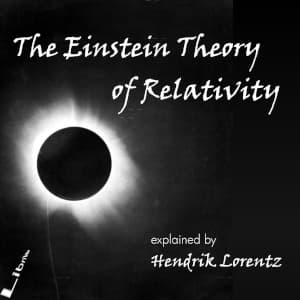

"All that is needed to follow his arguments is a bit of patience and time."
That's literally what Lorentz promises you at the start, and honestly? For a 55-minute audiobook about relativity written by one of the twelve people who supposedly understood it when Einstein first published — that's a pretty good deal.
I threw this on during a late-night debugging session last Tuesday. Kevin was asleep, I was staring at distributed system traces that made about as much sense as curved spacetime, and I figured: why not let a Nobel laureate explain the universe to me while I wait for my test suite to finish?
When a Nobel Laureate Writes the README
Here's the thing about Lorentz — the man's name is literally embedded in Einstein's equations. The Lorentz transformation. The Lorentz factor. He's not some science popularizer parachuting in to explain someone else's work. He was there. He was doing the groundwork before Einstein connected the dots. So when he says he's going to explain relativity without math, you're getting the explanation from someone who knows exactly which mathematical scaffolding he's choosing to leave out and why.
And it shows. The explanations are genuinely clean. He walks through the problem of measuring the speed of light, the failure of the ether hypothesis, how simultaneity breaks down — all the greatest hits of special relativity, but with this very methodical, almost engineering-minded approach. Think of it like reading really well-written documentation versus a Medium thinkpiece. There's no hand-waving. He just... explains things in order, building each concept on the last one.
But — and this is a real but — this was written in the early 1900s. The prose style is formal. Dense. European academic formal, which is a specific flavor. You can feel the era in every sentence. It's not dry exactly, but it demands your attention in a way that modern science communication doesn't.
Availle and the LibriVox Question
So let's talk about the elephant in the room. This is a LibriVox recording. Free, volunteer-narrated, public domain. Availle reads it straight — no dramatic flair, no sound design, just clear delivery of dense scientific text. And for what this is, that's... fine? The narration is competent and doesn't get in the way, which is honestly what you want for a text like this. You're not here for performance. You're here because a founding father of modern physics is explaining his peer's revolutionary theory to you directly.
But I'm not going to pretend the production quality competes with a studio-produced Audible title. There's a slight flatness to the audio that you notice if you've been spoiled by the Tim Gerard Reynolds and Ray Porter recordings of the world. It's clean enough, it's intelligible, but it's LibriVox.
The ROI Calculation
55 minutes. That's less than half a commute for me. Less than a single leg from SF to Mountain View. And what you get is a primary-source explanation of special relativity from someone who helped build the theoretical framework that made it possible.
The ROI on this audiobook is weird to calculate because it's free. The cost is literally just your time and attention. But here's my honest assessment: this is better as a reading experience than a listening one. The concepts are dense enough that I caught myself rewinding multiple times during my debug session. Lorentz builds arguments sequentially — if you zone out for 30 seconds and miss a conceptual step, the next two minutes won't land. This is NOT commute-worthy for a 6AM packed Caltrain. Not even close. This needs your actual brain.
Perfect for: a quiet evening when you want to feel smarter. Skip for: literally any situation where your attention is split.
Who This Is Actually For
If you're a physics-curious engineer (hi, that's me) who wants the historical perspective — hearing relativity explained by someone from Einstein's actual cohort — this is a cool artifact. It's like reading Kernighan and Ritchie on C instead of a modern textbook. The information delivery is dated, but there's something irreplaceable about getting it from the source.
If you want to actually learn relativity through audio, go grab a modern pop-science book. Brian Greene's narration of his own work will serve you way better.
But for 55 minutes of free scientific history from a literal Nobel Prize winner? I don't regret it. I just wouldn't spend a credit on it. The closest parallel I can think of for "historically significant but requires the right headspace" is Man on the Moon — another artifact where the value is almost entirely about being present for a specific moment in human achievement.
Commit Message: "Worth the Clone, Not the Fork"
This is a historical curiosity more than a modern learning tool. It's free, it's short, and it's narrated by someone who clearly respects the source material. Stream it on a quiet night when you want to remember that the universe is wilder than your codebase. Just don't expect it to compete with contemporary science audiobooks in accessibility or production value.


![Steve Jobs [unabridged audiobook] audiobook cover](/_next/image?url=https%3A%2F%2Fcovers.audiobooks.com%2Fimages%2Fcovers%2Ffull%2F9788499923406.jpg&w=1920&q=75)