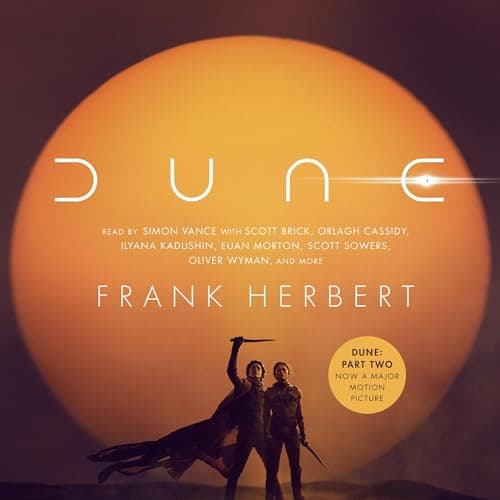

People talk about Dune like it's homework with sandworms. And look - I get why. It's dense, ceremonial, full of invented terms tossed at you like Frank Herbert expects you to keep up or get buried. But this audiobook, when it works, turns that density into atmosphere. I started it while closing the library one rainy evening, doing the deeply glamorous task of reshelving damaged hardcovers, and by the time I got home I was standing in my kitchen not moving, just letting Simon Vance's voice roll out all that prophecy and politics like scripture from a very hostile desert religion.
This is not a casual listen. Not even a little. If you want something to half-hear while answering emails, absolutely not. But if you can give it your attention? It opens up in a way the film adaptations only gesture toward.
Sand, ceremony, and the threat under every sentence
What still makes Dune hit this hard is that Herbert understands power as something spiritual, ecological, and deeply predatory. Arrakis isn't just a setting; it's an engine that grinds everybody down into strategy, faith, survival, or delusion. The spice economy, the Bene Gesserit breeding program, the way Paul Atreides is simultaneously a grieving son and a political project - it all creates this constant pressure. Horror isn't about gore - it's about dread. And Dune runs on dread. That slow-burn suffocation is something I chased again in Wife Between Us, where the dread comes less from sand and empire and more from the creeping realization that nothing you've been told is quite what it seemed.
Not jump-scare dread. Historical dread. Prophetic dread. The feeling that every choice has already been swallowed by a system bigger than the people inside it.
That's why the audiobook format actually suits it. You hear the ritual language, the formal confrontations, the internal calculations. You feel how often characters are not saying what they mean. Dune is basically a 21-hour lesson in subtext with knives. Paul's arc especially lands because he doesn't arrive as some swaggering chosen one. He starts vulnerable, watched, shaped by forces that want to use him. Euan Morton catches that beautifully - there's a tremor of uncertainty in Paul early on, but also this hardening conviction that creeps in as the mythology starts wrapping around him. That shift matters. Without it, Paul becomes symbol before he becomes person. Here, he stays unsettlingly human.
The cast giveth, the cast occasionally trips over itself
This is one of those hybrid productions where the ambition is obvious. You've got a full cast, music, sound effects, and moments where the scale really does click. Doors hiss. The score nudges scenes into something almost theatrical. Certain exchanges feel staged rather than merely read, which is exactly the right instinct for a novel this ceremonial. The narrator commits. That's rare.
Simon Vance is the anchor, and he earns that job. He has the steadiness this material needs - calm, authoritative, never trying too hard to sell the grandeur because the text is already grand enough. Scott Brick also has that easy, welcoming quality that helps with Herbert's terminology-heavy passages. When the production settles into its rhythm, it's immersive in a way that's pretty intoxicating.
But. This audiobook has a real identity problem, and pretending otherwise would be useless.
Because it switches between full-cast scenes and stretches handled by a primary narrator, some characters can effectively have two voices. Not metaphorically. Literally. Simon Vance may voice a character's internal thoughts one way, then a scene shifts and that same character sounds noticeably different in the cast performance. If you're locked in, you can adjust. If you drift even a little, it can be disorienting. This is why I kept saying you need focus.
And some performances push a bit too hard. A few listeners have complained that certain voices go overdramatic, and yeah, I heard that. The one that seems to divide people most is Scott Sowers as Gurney Halleck, and I understand the complaint. It didn't ruin the book for me, but it did pull my attention sideways more than once. In a production this carefully built, one distracting voice stands out fast.
So no, it's not flawless. It's a bold, slightly messy adaptation of a difficult novel. I'd still rather have that than a flat single-tone reading that sands off all the weirdness.
Who Should Listen (And Who Should Skip)
If you love layered world-building, political maneuvering, invented religions, and books that trust you to keep up, this is absolutely your thing. If the idea of ecology and empire being discussed with the intensity of a curse sounds delicious - welcome. My podcast listeners are going to love this.
If you prefer clean, simple audio grammar where every voice remains perfectly consistent from scene to scene, you may get annoyed. Same if you want fast pacing. Dune is not in a hurry. It stalks. It chants. It buries meaning in conversation and expects you to dig. Skip it, too, if you need background-friendly listening - the production style almost tricks you into thinking it'll be easy. It isn't. This is a dedicated-listen audiobook. Headphones help. A little patience helps more.
What I appreciated most, honestly, is that this version doesn't flatten Dune into "important sci-fi." It leaves the strangeness intact - the mysticism, the manipulation, the sense that Paul's rise is both thrilling and terrifying. That matters. Too many conversations about Dune stop at the world-building and miss the menace humming underneath it.
So yes, there are narration inconsistencies. Yes, the full-cast structure can wobble. But the scale, the intelligence, and that dry, prophetic unease still come through. I listened with the lights low. Mistake? Maybe. Worth it? Absolutely.
Put it this way: if you've always meant to read Dune and kept bouncing off the page, this audiobook might be your way in. Just give it your whole brain. Arrakis demands tribute.