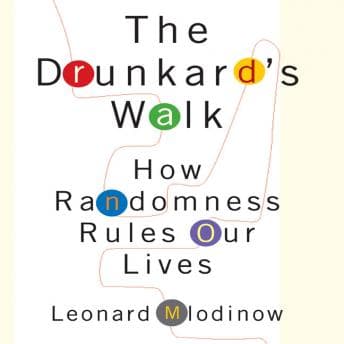

I'm sitting here with a stack of undergrad papers to grade, a glass of cheap Pinot Noir, and this audiobook in my ears, and I honestly can't tell what's more frustrating: my students' inability to grasp correlation versus causation, or the fact that this audiobook's editor apparently fell asleep at the wheel.
Let's get the rant out of the way first, because—wow. The reviews warned me. They said Sean Pratt sounds "detached." I can handle detached. I'm a researcher; I live for clinical detachment. But what I can't handle is the audio equivalent of a stutter step. There are pauses in the middle of sentences so long I actually checked my phone to see if the battery died. Worse, there are actual repeated phrases left in the final cut. Not for emphasis—mistakes. It sounds like a rough draft that nobody bothered to clean up. For a book about randomness, the editing feels a bit too chaotic for my taste. The dead air between chapters is long enough to contemplate your own mortality, or at least long enough for me to question why I didn't just buy the paperback.
The Psychology That Kept Me Listening Anyway
But—and it's a significant *but*—Mlodinow is brilliant. If you can grit your teeth through the technical glitches, the actual content here is fascinating. He breaks down how we force narratives onto statistical noise, which is basically my entire job description. The section on wine ratings being essentially random nonsense? Vindication. I will absolutely be using that data point the next time my mother criticizes my wine selection at dinner. "Maa, the correlation between price and quality is negligible." She won't care, but I'll feel better.
He also tackles the Roger Maris home run record, dismantling the "hero" narrative to show it was likely just statistical variance. It's the kind of cold, hard pattern recognition my brain craves. We want to believe CEOs and movie stars are geniuses, but Mlodinow argues they're mostly just the beneficiaries of a coin flip landing heads ten times in a row. Eat a Peach explores a similar tension—the myth of the self-made success story versus the role of timing and luck in David Chang's rise. Terrifying and weirdly comforting, all at once.
Who Gets the Most Out of This (And Who Should Run)
If you're the type who gets genuinely excited about dismantling cognitive biases—or if you've ever wanted ammunition against anyone who claims they "earned" their success purely through grit—this is your book. Skip it if bad audio production makes your eye twitch uncontrollably; you might be better off with the print version.
My Final Grade (With Caveats)
Here's the dilemma: The content is a solid five-star lecture on human folly. The production value is a one-star disaster. If you're like me and sloppy editing pulls you right out of the material, maybe skip the headphones. But if you can tune out the awkward pauses and focus on the math, Mlodinow might just change how you see the world—or at least, how you see your own luck.