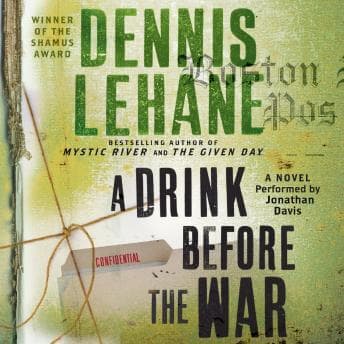

I was sitting in the break room at 2 AM eating lukewarm pancit my mom packed me (yes, I'm 38 and my mother still sends me to work with food), and I realized I'd been thinking about this book for three straight shifts. Not the plot - the feeling. That sick, heavy weight Dennis Lehane drops on you when Patrick Kenzie starts pulling threads in a case that was supposed to be simple and clean.
Drink Before the War is Lehane's debut, and knowing what he'd go on to write - Mystic River, Shutter Island - you can hear the foundation being poured here. It's rougher around the edges than his later work, but honestly? That rawness is part of what makes it hit.
Boston's Ugliest Truths Wrapped in a Missing Persons Case
The setup sounds almost quaint: powerful politicians hire two PIs to find a cleaning woman who swiped some documents. Easy money. Except Lehane uses that framework like a scalpel - he cuts through class, race, politics, and the particular brand of violence that festers in neighborhoods people pretend don't exist. Kenzie and Gennaro aren't your typical hard-boiled duo. They grew up in Dorchester. They know these streets because they got beat up on them. And that intimacy with the setting makes every revelation land harder because it's personal for them.
What got me - and I mean genuinely got me, Carlos asked why I was sitting in the driveway with the engine running - is how Lehane handles the abuse in this story. He doesn't sensationalize it. He doesn't use it as a cheap plot device. That same refusal to look away from ugly, documented truth is something I kept thinking about while listening to Betrayal of Anne Frank: A Cold Case Investigation — though I had very different feelings about how that one earned its darkness. He presents it the way I've seen it presented in trauma bays: matter-of-fact, devastating, and impossible to look away from. The violence isn't gratuitous but it IS unflinching. Content warnings are real on this one - abuse, sexual violence, language. Lehane doesn't let you stay comfortable.
The relationship between Kenzie and Angie Gennaro has this tension that isn't just will-they-won't-they romantic nonsense. It's built on shared history, shared damage, and the kind of trust you develop when you've known someone since you were both kids getting screamed at by nuns. Their dynamic carries the emotional weight even when the plot mechanics get a little wobbly in the middle act.
Jonathan Davis Knows How to Sound Like He Needs a Drink
Jonathan Davis - three-time Audie winner, Narrator Hall of Fame, the man has credentials - brings exactly the right amount of gravel and weariness to Kenzie's first-person narration. His voice sounds like someone who's been up too long and seen too much, which, as a night shift nurse, I relate to on a molecular level. He uses distinct accents for the supporting cast without going full cartoon, which I appreciate. The Boston politicians sound different from the street-level characters, and that class divide comes through in the voice work alone.
Is it the most dynamic narrator performance I've ever heard? No. Davis keeps things relatively grounded, which serves the material. This isn't a book that needs vocal pyrotechnics. It needs someone who can carry Lehane's prose - which swings between sharp dialogue and these longer, more reflective passages about the neighborhood - without making either feel forced. Davis handles that well.
The Medicine of It (Sort Of)
Look, this isn't a medical thriller, so I didn't get my usual opportunity to yell at my dashboard about defibrillator protocols. But there are scenes involving injury and aftermath, and Lehane writes physical violence the way it actually works - messy, shocking, and with consequences that linger. Nobody takes a beating and shows up fine the next chapter. As someone who's actually worked a code and patched up people after bar fights and worse, I notice when writers understand that bodies break in specific, ugly ways. Lehane gets it.
Who Needs This in Their Ears
If you're a Lehane fan who started with Mystic River or Shutter Island and never went back to the beginning - go back. This is where it all started, and at under nine hours, it's a tight commitment. If you want noir that earns its darkness instead of just posing with it, this is your book. If you need your mysteries clean and your endings tidy, keep walking.
Not great for bedtime listening. The subject matter is heavy enough that you'll be staring at the ceiling afterwards. Perfect for that post-shift decompression, though - the kind of drive home where you need something that matches the weight of what you just dealt with instead of pretending everything's fine.
Night Shift Approved, With a Warning
This won a Shamus Award for Best First Detective Novel in '94, and it deserved it. It's not perfect - the pacing dips in a few spots, and some of the political maneuvering feels a touch too neat for how messy everything else is - but Lehane's voice was already so distinctly his own. Davis's narration matches the grit without overdoing it. I'm starting the next Kenzie-Gennaro book tomorrow.
My mom would love this. She still thinks I should've been a doctor, but she reads more crime fiction than anyone I know. Filipino moms contain multitudes.