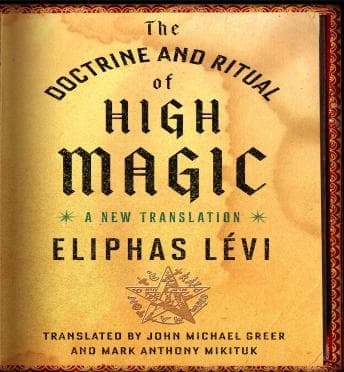

What happens when a 19th-century French occultist who was trained for the priesthood decides to write the definitive guide to ceremonial magic? You get nearly seventeen hours of dense, fascinating, occasionally baffling material that I found myself genuinely unable to stop thinking about.
I started this during one of those 2 AM insomnia spirals where my brain refuses to shut off. Perfect timing, honestly. There's something about Lévi's voice - filtered through Greer and Mikituk's translation, delivered by Sean Pratt's measured narration - that feels appropriately liminal. Like you're supposed to be receiving this information in the dark, half-dreaming.
The Psychology of the Occult Mind
Here's what fascinated me as someone who studies why humans believe what they believe: Lévi wasn't a charlatan. The research actually shows he was educated for Catholic priesthood before getting expelled for "unorthodox teachings" - and you can feel that theological training in every chapter. His framework for magic is essentially a psychological system dressed in esoteric language. He's talking about willpower, imagination, and the manipulation of consciousness, but he's using the vocabulary of Kabbalah and Rosicrucianism.
This is a striking case study in how 19th-century minds processed what we'd now call psychology. Lévi predates Freud by decades, yet he's essentially describing the unconscious, symbolic thinking, and the power of ritual to restructure mental patterns. My therapist would have thoughts about this character - except he's not a character, he's a real person who genuinely believed he'd cracked the code of the universe.
The book is divided into doctrine (theory) and ritual (practice), and the tension between them is revealing. Lévi clearly wanted to be taken seriously as a philosopher, not dismissed as a mere practitioner of spooky ceremonies. Classic intellectualization at work - using elaborate theoretical frameworks to legitimize practices that mainstream society would mock.
Seventeen Hours Is A Commitment (But Hear Me Out)
Let's be honest about what you're signing up for. This is not a casual listen. The duration alone signals that Lévi had Opinions and he was going to share all of them. Some sections drag - particularly when he's explaining correspondences between Hebrew letters and tarot symbolism that require you to actually visualize the cards. Audio format struggles here.
But Sean Pratt handles the density admirably. His delivery is clear without being clinical, engaged without being theatrical. For material this esoteric, that's exactly right. You don't want someone performing the text like it's a fantasy novel. Pratt treats it like what it is: a serious philosophical work that happens to be about magic.
I found myself asking: why does this book still matter 170 years later? The answer is in the lineage. Lévi's ideas directly influenced Blavatsky, the Golden Dawn, Aleister Crowley, and eventually the entire New Age movement. Understanding this text is like reading the source code for a huge chunk of Western alternative spirituality.
Who This Is Actually For (And Who Should Run)
If you're casually curious about "the occult" and want something spooky for Halloween - skip this. Seriously. You'll be bored by hour two.
If you're a serious student of esoteric traditions, religious history, or the psychology of belief systems, this is essential. The Greer/Mikituk translation apparently fixes significant problems with older English versions (the research mentions "dated and inaccurate translations" that frustrated seekers for years). I can't compare directly, but the prose flows well for 1854 material.
If you're researching narrative psychology, symbolism, or how humans construct meaning through ritual - unexpectedly valuable. Lévi understood something fundamental about how symbols operate on the mind.
The Case Study Closes
I finished this at 5 AM, which feels appropriate. Lévi believed magic operated in liminal spaces - thresholds, twilight, the edges of consciousness. Whether you believe any of his claims (I remain professionally skeptical but personally intrigued), the book offers something rare: a complete, internally consistent worldview from a brilliant, probably slightly unhinged mind.
Psychologically, it tracks. That's the surprising thing. Strip away the ceremonial language, and Lévi is describing attention, intention, and the power of structured belief to reshape experience. Year of Yes explores a similar transformation through deliberate practice, though Shonda Rhimes would probably laugh at the ceremonial robes. We have different words for this now. We call it cognitive behavioral therapy, or visualization, or mindfulness. Lévi called it magic.
Maybe he wasn't wrong. Maybe he was just early.