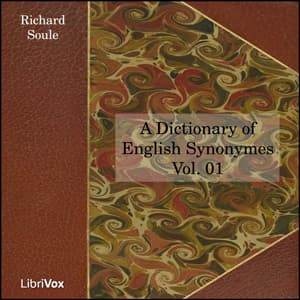

It was 11:30 on a Tuesday night. Papers half-graded, red pen dying, Denise already asleep. I needed something to keep me awake but not so engaging that I'd abandon my stack of sophomore essays on The Great Gatsby. So I reached for what might be the least narratively compelling audiobook ever produced: a dictionary of synonyms from 1871.
I'm not being sarcastic. I genuinely wanted this.
The Strangest Bedside Companion I've Ever Chosen
Let me set expectations here, because this isn't really an audiobook in any traditional sense. Richard Soule's Dictionary of English Synonymes is exactly what it says - an alphabetical catalog of English words and their parallel expressions. "Abandon" gives you "desert, forsake, leave, relinquish, evacuate." Then you move on. For three hours and forty-four minutes. Through the letter C, because this is only Volume 01.
And honestly? There's something almost meditative about it. Soule wasn't writing for entertainment. He was building a tool, a practical guide for writers and speakers who wanted precision in their word choices. As someone who spends his days begging sixteen-year-olds to use something other than "good" and "bad" in their analytical paragraphs, I felt seen. This is the book I want to assign. My students would hate this. I love it.
But let's talk about what this actually is in audiobook form. LibriVox designed this project specifically as a training ground for new volunteer readers. That's the description. That's the stated purpose. So you're not just listening to synonym clusters - you're listening to a rotating cast of amateur narrators learning how to use their recording equipment in real time.
Thirty Different Voices Reading You the Same Kind of Sentence
This is where it gets interesting, and also where it gets rough. The narrator rotation means you might go from a crisp British male voice with excellent intonation to someone reading too fast with a hot microphone, sometimes within the same letter of the alphabet. The inconsistency isn't subtle. One reader will give you beautiful, measured pacing - "Abjure. Renounce, forswear, reject, relinquish, repudiate" - and you're nodding along, almost hypnotized. Then the next section sounds like someone recorded it in their kitchen during a rainstorm.
Some of the volunteer readers genuinely shine. There's a clarity and warmth in the best performances that makes you realize how much interpretation exists even in reading a reference book. The narrator understands that pause is punctuation - at least, the good ones do. The spacing between the headword and its synonyms, the rhythm of the list, the slight emphasis on the first term. It matters.
But then there are mispronunciations. In a book about words. That's... rough. I caught a few that made me wince, and I say this as someone who routinely mispronounces "quinoa" in the faculty lounge.
The production is bare bones - no music, no effects, just voice and silence. Which is correct for this kind of material. You don't need a string quartet behind "Abbreviation: abridgment, contraction, curtailment, reduction, shortening."
Who Walks the Lakefront Listening to a Synonym Dictionary
Me, apparently. I switched from late-night grading companion to Sunday morning walk material, and something shifted. With the lake on my left and Soule's clusters of near-identical words rolling through my earbuds, I started actually thinking about the differences between synonyms - the way "abandon" and "forsake" carry completely different emotional weight despite meaning roughly the same thing. This reminds me of what Hemingway said about the difference between the right word and the almost-right word being the difference between lightning and a lightning bug. (Yes, I know that's actually Twain. I teach English. I was testing you.)
At 1.0x speed - and honestly, I'd even recommend going slower if your app allows it - you can treat this as a vocabulary meditation. It's not entertainment. It's exercise for the part of your brain that cares about language.
Should you listen to this? If you're a writer, a teacher, a crossword obsessive, or someone who genuinely enjoys the architecture of English, there's a weird pleasure here. If you want story, character, conflict, emotion - you're in the wrong aisle entirely. This is a reference book read aloud by people learning to read aloud. The rotating-narrator chaos here reminded me of something structurally similar - Short Science Fiction Collection 004 runs the same LibriVox volunteer gauntlet, and the quality swings are just as pronounced, though at least there you get actual plot to carry you through the rough patches. Set your expectations at that altitude and you might be surprised.
The Assignment I'd Never Actually Give
This is a curiosity more than a recommendation. It's free on LibriVox, it's short enough to finish in a few sessions, and it gave me more to think about than I expected from what is essentially a spreadsheet of words. The variable narrator quality keeps it from being something I'd actively push on anyone, but as a linguistic oddity and a surprisingly pleasant background companion for late-night paper grading? I've heard worse. I've assigned worse.