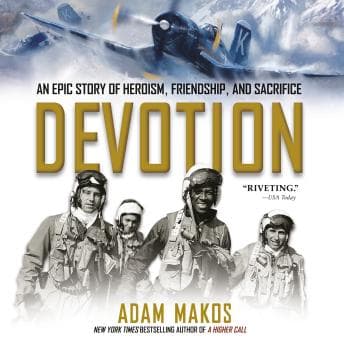
"How far would you go to save a friend?"
That question sat with me for about three days after I finished this one. I was up late, couldn't sleep — one of those nights where the house is quiet and Linda and Ranger are both out cold, and I'm just sitting on the back porch with my earbuds in, staring at nothing. Somewhere around hour twelve, when Tom Hudner deliberately crash-lands his Corsair behind enemy lines to try to pull Jesse Brown from a burning wreck, I stopped breathing. Not figuratively. I actually held my breath.
Let me cut to the chase: Adam Makos wrote a hell of a book. The audiobook version? That's more complicated.
Two Wingmen Who Had No Business Being Friends
The heart of Devotion is the friendship between Tom Hudner and Jesse Brown — a Harvard-eligible white kid from Fall River, Massachusetts, and the Navy's first Black carrier pilot, a sharecropper's son from Hattiesburg, Mississippi. What Makos does well is refuse to make their friendship some neat, Hollywood-ready racial reconciliation story. Jesse doesn't need saving from racism — he's already tougher than everyone around him. He taught himself to fly by lying in a ditch at the end of a runway, watching planes take off and land, memorizing every movement. That detail alone tells you everything about the man. I've been thinking lately about what it takes to truly master something against all odds — the kind of relentless self-teaching Jesse Brown embodied — and Overcoming Dyslexia surprised me with how much it illuminates that same grit in a completely different context.
Makos clearly did their homework. The carrier operations aboard the USS Leyte are described with the kind of precision that makes me trust an author. He gets the LSO (Landing Signal Officer) procedures right. He understands that landing a Corsair on a carrier deck isn't just dangerous — it's specifically dangerous because of that long nose blocking your forward visibility during approach, forcing pilots into a curving descent. Details like that matter. When an author nails the small stuff, I trust them with the big stuff.
The Korean War chapters are where the book earns its weight. The Chosin Reservoir fighting — Marines surrounded, outnumbered maybe eight to one by Chinese forces in temperatures hitting forty below — Makos puts you on the ground with guys like PFC Red Parkinson and then yanks you into the cockpit with Tom and Jesse flying close air support. The alternating perspectives between ground and air actually work because Makos doesn't rush them. You feel the Marines' desperation and then you feel the pilots' frustration at not being able to do enough.
I've seen this scenario play out in real life — being in the air while guys on the ground are in trouble, knowing your ordnance is limited and the weather's closing in. Makos captures that helplessness without overdramatizing it.
The Narrator Problem You Need to Know About
Here's where I have to be honest. Dominic Hoffman has a clean, deep voice. Good mic presence. Zero audio issues. But — and this is a significant but — his delivery is flat. Technical. Almost clinical. During the Elizabeth Taylor scenes on the Riviera (yes, that's a real subplot, and it's actually entertaining), his read has the same emotional temperature as when Jesse's Corsair gets hit by anti-aircraft fire. There's no gear shift.
I listened at 1.25x, which actually helped the pacing feel more natural, but it couldn't fix the fundamental issue: this story demands emotional range, and Hoffman reads it like a well-organized briefing. Jesse Brown's wife Daisy — her fear, her pride, her loneliness as a Black woman in a Navy world that barely acknowledges her existence — deserves a narrator who can put some weight behind those passages. Hoffman gives them the same measured delivery he gives the technical specs on the F4U Corsair.
Did it ruin the book? No. The writing is strong enough to carry you through. But I'd be lying if I said there weren't stretches, especially in the middle third, where I had to actively fight disengagement. This is a story that made me cry on my back porch at midnight — imagine what it could've done with a narrator who matched Makos's emotional investment.
Who Should Strap In and Who Should Eject
If you care about the Korean War — America's forgotten war, the one that killed 36,000 Americans and somehow gets half a chapter in most history books — this is essential listening. If you've read A Higher Call and trust Makos, you won't be disappointed by the writing. Military aviation enthusiasts, this is your lane.
But if you're the kind of listener who needs vocal performance to stay locked in, consider grabbing the print version instead. Seriously. The story deserves a 5. The narration knocks it down. That's the honest debrief.
Ranger fell asleep during this one, but I'm pretty sure that was Hoffman's delivery and not the content. Mission accomplished — mostly.






![Steve Jobs [unabridged audiobook] audiobook cover](/_next/image?url=https%3A%2F%2Fcovers.audiobooks.com%2Fimages%2Fcovers%2Ffull%2F9788499923406.jpg&w=1920&q=75)