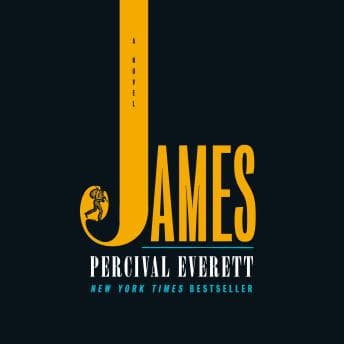

I was walking the lakefront with Denise last Sunday — one of those rare October mornings where Chicago decides to be kind — when Dominic Hoffman, speaking as James, slipped out of dialect mid-conversation and revealed the articulate, philosophical mind he'd been hiding from white people for his entire life. I stopped walking. Denise asked if I was okay. I was not okay. I was standing on the concrete path near Montrose Harbor having a quiet crisis about every time I've taught Huckleberry Finn in twenty years of high school English.
Let me back up.
The Book Twain Should've Written (But Couldn't Have)
Percival Everett takes the scaffolding of Adventures of Huckleberry Finn — the raft, the river, the Duke and Dauphin, the storms and stopping points — and hands the story to the person who was always the most interesting character in it. Jim. Except his name is James. That distinction matters enormously, and Everett makes you feel exactly why.
The central conceit is devastating in its simplicity: the enslaved people in this novel speak in dialect around white folks because that's what keeps them alive. But among themselves? They're articulate, educated, debating philosophy. James teaches enslaved children how to code-switch — how to flatten their grammar, how to perform ignorance convincingly enough to survive. There's a scene early on where he drills kids on speaking "wrong" the right way, and it plays as comedy until you realize what you're actually watching. It's a survival class. The humor curdles in your throat.
This is what Everett does better than almost anyone writing today. He makes you laugh, then makes you reckon with why you laughed. I noticed something similar happening in Worries of a Winter Walk, where the humor kept undercutting itself in ways I wasn't prepared for — though Everett's stakes are, obviously, of an entirely different order.
I've taught Twain's novel probably thirty times. I've given the speech about how Twain was satirizing racism, how Jim's humanity shines through despite the dialect, how the ending is a problem but the journey matters. And I believed all of that. I still do, mostly. But listening to James, I kept thinking about all the things I'd glossed over. How comfortable I was with Jim as a passenger in someone else's story. Everett doesn't let you stay comfortable.
Hoffman Understands That Silence Is a Sentence
Dominic Hoffman's performance is the reason this needs to be heard rather than read. And I don't say that lightly — the prose deserves to be savored on the page too. But Hoffman does something extraordinary with the vocal shifts between James's "white folks" voice and his real voice. The dialect performance isn't caricature; it's a man consciously degrading his own speech to stay alive. And when James drops the mask — when he slips, or when he's alone, or when he's with other enslaved people — Hoffman's voice opens up. Becomes precise. Warm. Intellectual. The narrator understands that pause is punctuation, and Hoffman deploys silence like a weapon.
There's a moment — and I won't spoil the context — where James accidentally reveals his true voice in the wrong company. Hoffman plays the terror of that slip so quietly, so physically, that I felt my own chest tighten. No dramatic music. No production tricks. Just a man's voice catching on the realization that he may have just gotten himself killed by sounding too smart.
At seven hours and forty-nine minutes, the pacing never drags. Everett keeps the plot moving — there's genuine danger, genuine adventure, moments that are genuinely funny in a lacerating way — but the real engine is James's interiority. His thoughts about language, power, fatherhood, what it means to be seen as less than human by people who are, by any honest measure, less thoughtful than you are.
Who This Is Really For
If you loved Huckleberry Finn, listen to this. If you hated Huckleberry Finn, listen to this harder. If you've ever taught American literature and felt that nagging sense that you were explaining away things that deserved more than explanation — yeah. This one's for you.
My students would — actually, no. My students might love this. The ones who roll their eyes when I assign Twain, who ask me why we're reading a book with that word in it, who want to know why we keep centering white perspectives on Black suffering. James is the answer I didn't have for them. Or maybe it's the question I should've been asking.
This is not background listening. Don't put this on while grading papers at 11 PM. (I tried. I had to stop grading.) Give it your full attention. Listen at 1.0x because the language shifts are the entire point and you'll miss them if you're racing through.
I will say: content warnings for violence and racist language are warranted. Everett doesn't sanitize slavery, and Hoffman doesn't soften the delivery. It should be uncomfortable. It is.
Worth Pausing the Faculty Meeting For
This reminds me of what Toni Morrison said about the function of racism — it keeps you explaining, over and over, your right to exist. James is a novel about a man who is smarter than almost everyone around him, forced to perform stupidity as a condition of survival. And Percival Everett wrote it with the kind of controlled fury that makes you want to go back and annotate every American novel you thought you understood.
Pulitzer, National Book Award, Kirkus Prize — the hardware is justified. But forget the awards. This is why we still read the classics: so someone can come along and crack them open and show us what we missed the first time.
Denise and I finished it on the same walk, three Sundays later. She looked at me and said, "You're going to redo your whole Twain unit, aren't you?" She knows me too well.