
So here's the thing - I expected this to be a quick, lightweight palette cleanser between heavier listens. Something to fill a single commute and then forget. I was wrong.
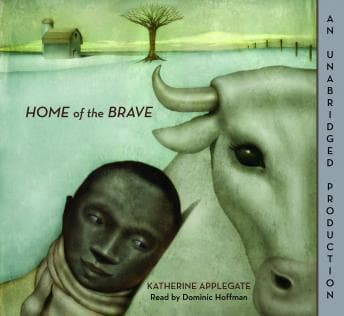
I started Home of the Brave at 6:14 AM on a Tuesday, standing in my kitchen waiting for the coffee to finish dripping, and I finished it before I even got to Mountain View. Two hours and forty-seven minutes. One commute. And I sat in the Caltrain parking lot for the last eight minutes because I couldn't bring myself to pause it and walk to the office.
Let me back up.
Free Verse on a Train Full of Sleeping Engineers
This is a novel written entirely in free verse poetry. For a kid. About an African refugee named Kek navigating his first Minnesota winter after losing most of his family. And somehow Katherine Applegate - yes, the Animorphs Katherine Applegate, which broke my brain a little - turns this into something that hits way harder than books three times its length.
The format is the secret weapon here. Each poem is short, sometimes just a few lines, and Dominic Hoffman reads them with these deliberate pauses between stanzas that let the words just... land. There's a rhythm to it that works absurdly well in audio. Your brain doesn't have to track complex plot threads or remember fourteen character names. It's almost meditative. Kek describes snow as something that "stings" and wonders if the people here will be like the winter - cold and unkind. Simple images, but they accumulate.
The commute-worthiness paradox: it's easy to follow at 6 AM (short poems, clear language, minimal cognitive load), but the emotional weight sneaks up on you. I was fine, fine, fine, and then Kek names a cow on an old woman's farm - the name means "family" in his language - and suddenly I'm trying not to cry next to a guy manspreading into my seat.
Hoffman's Voice Is a Weird Perfect Fit
Okay, I need to address this. Dominic Hoffman has this older, weathered quality to his voice. And Kek is a kid. So for the first ten minutes, my brain was doing a type mismatch error - like, why does this child sound like he's lived seventy years? But then it clicked. Kek HAS lived seventy years of experience compressed into a child's body. He's seen things no kid should see. The weariness in Hoffman's delivery isn't a bug, it's a feature. Once I stopped fighting it, the voice became the story.
Hoffman's a Golden Voice winner from AudioFile for a reason. He doesn't do flashy character voices - this isn't Ray Porter doing fifteen distinct aliens (I love you Ray, call me never) - but he handles the lyricism of the free verse like he's reading poetry at a very quiet, very sad open mic. The pauses do so much heavy lifting. He lets silence be part of the narration, which is brave in audio where dead air usually feels like a production error.
That said, I knocked his rating slightly because there's not a ton of character differentiation. Kek, his cousin Ganwar, the foster care girl, the old farm woman - they all come through the same vocal filter. For a book this short it's fine, but I noticed it.
The Engineer's Take on Efficiency
The ROI on this audiobook is genuinely absurd. Sub-three hours for a story that's going to stick with me longer than half the 20-hour sci-fi epics I've plowed through this year. Applegate is ruthlessly efficient - every poem earns its place. No filler. No padding. No chapters that could've been blog posts. (Business book authors, take notes. Take ALL the notes.)
This is basically The Martian but for emotional survival instead of physical survival - one person, hostile environment, figuring it out piece by piece with limited resources. Except instead of potatoes, Kek has a cow named Family and the stubborn hope that his mother is still alive somewhere.
Who This Is For (and Who Should Calibrate Expectations)
Perfect for: commute, bedtime, or any gap in your listening queue where you need something short and complete. If you've got a soul and two hours, you're the target audience.
Skip if: you need plot complexity, hard magic systems, or anything resembling action. This is quiet. It's a mood piece dressed as a middle-grade novel. Also skip if free verse makes you twitchy - there's no getting around the format.
Parents: this is an incredible one to listen to WITH your kids. The language is accessible but the themes are real.
Commit to the Short Queue
I fixed a P0 incident last Thursday that took less time than this audiobook. This book will outlast that fix in my memory by years. Sometimes the smallest deployment has the biggest impact. Grab this for your next short commute day or when you need a reset between heavy series. Though fair warning: I said the same thing about Atomic Habits being a quick reset listen, and that one rewired how I think about productivity systems for the next six months. You won't regret spending the credit - though honestly, at under three hours, check your library app first.