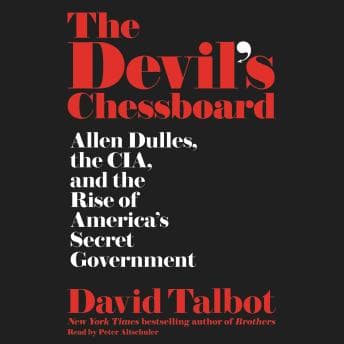

Twenty-five hours. That's what I spent with Allen Dulles in my ears, and honestly? I'm still processing. Not because the narration was particularly memorable—it wasn't—but because Talbot basically wrote a business case study for how to build an empire that answers to no one. As someone who's spent years watching organizations scale, fail, and occasionally commit fraud, this book hit different.
Bottom line upfront: this is essential listening if you want to understand how American power actually works. Not the civics textbook version. The real version. The one where a guy who should've been a managing partner at a white-shoe law firm instead decided to run covert operations like a private equity fund with assassinations.
The MBA Program Nobody Wanted
Here's what got me. Dulles didn't just run the CIA—he treated it like his personal consulting practice. Client relationships with Nazi industrialists? Check. Hostile takeovers of foreign governments? Absolutely. Stakeholder management that included the Mafia? You bet. I've seen this playbook before, just usually without the body count.
Talbot's research is genuinely impressive. The guy dug up correspondence from Dulles's wife AND mistress. He found documents that were supposed to stay buried. That same commitment to primary sources shows up in Fire and Fury, though Wolff's access came from a very different kind of institutional chaos. This isn't some conspiracy blog post stretched into a book—it's investigative journalism with receipts. The sections on Operation Paperclip and how we basically hired Nazi scientists because, well, efficiency? That's the kind of moral bankruptcy I've watched companies rationalize in boardrooms. Different scale, same logic.
My parents would've understood Dulles immediately, by the way. Not because they agreed with him—God no—but because they recognized the type. The customer who smiles while underpaying. The landlord who makes promises he never intends to keep. Power that operates in the gaps between what's legal and what's enforceable. They just didn't have a term for it. I Know Why the Caged Bird Sings explores a different kind of power operating in those gaps—the kind my parents would've recognized from the other side. Talbot calls it "America's secret government." My mom would've called it something in Korean that doesn't translate politely.
Peter Altschuler: The Toyota Camry of Narrators
Peter Altschuler is... fine. He's the Toyota Camry of audiobook narrators—reliable, clear, gets you where you need to go. At 25 hours, that actually matters more than you'd think. I listened to most of this during a consulting project in Phoenix, driving between client sites, and his voice never grated. Never made me want to switch to music.
But here's the thing—this book probably needed more. The material is explosive. We're talking about a guy who Talbot essentially accuses of being involved in the Kennedy assassination. And Altschuler delivers it like he's reading quarterly earnings reports. Competent. Professional. A little... flat?
I bumped it to 1.5x after the first few hours. Not because it was bad, but because the pacing didn't match the content's intensity. At that speed, it felt more appropriate. Like the urgency the material deserved finally showed up.
What Your Business Books Won't Tell You
This is what my McKinsey training never covered—what happens when the optimization mindset gets applied to democracy itself. Dulles wasn't stupid. He was terrifyingly competent. He built systems, cultivated relationships, managed up and down simultaneously. He would've crushed it in private equity. Instead, he decided American foreign policy should operate like a black-box algorithm that only he understood.
The JFK material is going to be controversial. I'll say this: Talbot makes a case. Whether you buy it depends on how much institutional skepticism you've accumulated. After watching three different companies I consulted for hide problems until they exploded publicly, my threshold for "they would never do that" is pretty much gone.
Jenny says I'm being harsh about the narration. Jenny is right. Altschuler does solid work with difficult material. But I kept thinking about how this would land with someone like Michael Kramer or Scott Brick behind the mic. The difference between good and great in audiobooks is the difference between information transfer and experience. This lands closer to the former.
The ROI Calculation
If you're interested in how power really operates—not the org chart version, the actual version—this is mandatory. If you want to understand why certain foreign policy decisions seem insane from the outside, Talbot provides context that explains (not justifies) a lot. If you're building anything that could become an institution, this is a cautionary tale about what happens when accountability gets designed out of the system.
Skip it if you need your history dramatic and theatrical. Skip it if 25 hours feels like too much. Skip it if you're not ready to feel deeply uncomfortable about American exceptionalism.
I finished it, which is more than I can say for 70% of my Audible library. My 2.0x speed couldn't save the slower sections, but at 1.5x, this became the most disturbing business education I never asked for.



![Steve Jobs [unabridged audiobook] audiobook cover](/_next/image?url=https%3A%2F%2Fcovers.audiobooks.com%2Fimages%2Fcovers%2Ffull%2F9788499923406.jpg&w=1920&q=75)