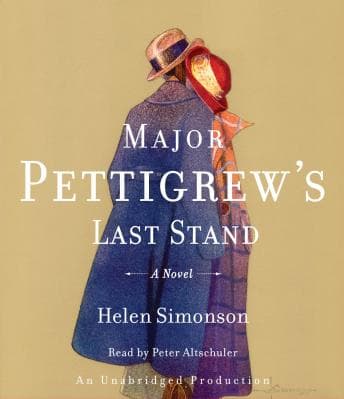

Major Pettigrew is exactly the kind of character my students would dismiss as 'boring old guy stuff' in the first five minutes. They would be catastrophically wrong.
I finished this one on a Saturday morning walk along the lakefront with Denise, which turned out to be almost too perfect - the lake was doing that grey, quietly dignified thing it does in October, and here's this retired British major doing his own quiet, dignified thing in a small English village, trying to figure out what the rest of his life is supposed to look like after sixty-something years of following everyone else's rules. Denise kept asking why I was laughing to myself. I kept saying 'I'll explain later.' I never really did.
The Englishman Who Couldn't Help Being Himself
Helen Simonson's Major Ernest Pettigrew is one of those fictional characters who feels less invented than discovered. He has opinions about tea. Strong, non-negotiable opinions. He has opinions about his son Roger - who is, and I say this with complete affection for the novel's construction, an absolute twit of the highest order. The scenes between the Major and Roger are the kind of generational comedy that makes you wince because you've either been Roger or you've raised one. The Major's slow-burning exasperation, his commitment to decorum even when decorum is clearly losing, his genuine bewilderment that the world stopped being the world he understood - Simonson writes all of this without a single note of condescension toward him.
And then Mrs. Jasmina Ali walks in. Pakistani shopkeeper, recently widowed, equally well-read, equally tired of people's nonsense. Their friendship - which becomes something more, slowly, carefully, the way real things actually develop between adults who've already lived whole lives - is built on shared grief and shared literary taste. Let's talk about what Simonson is really saying here: that the things that actually connect people have nothing to do with the categories society insists on sorting them into. The village of Edgecombe St. Mary has very firm ideas about who belongs where. The novel has very firm ideas about how wrong they are. It makes its argument through character rather than lecture, which is the only honest way to make it. Jane Eyre operates on the same principle - the social critique lands because you're too invested in the people to notice you're being argued at.
This is why we still read the classics - and why we need new books that understand what the classics understood. If you loved E.M. Forster's interest in Englishness bumping up against the wider world, this is its spiritual successor, updated and warmer and funnier.
What Peter Altschuler Gets Right (And Almost Gets Too Right)
Peter Altschuler's narration is doing serious work here. His Major Pettigrew has this particular quality of gruffness - not mean, not cold, but defended, the voice of a man who expresses care through mild disapproval and considers that perfectly adequate communication. The comedic timing on the Roger scenes is genuinely sharp. Altschuler understands that the Major's dignity is the joke and the point simultaneously, and he doesn't break it even when the situation is absurd.
The narrator understands that pause is punctuation - there are moments in the Major's internal monologue where Altschuler lets a beat sit before the character catches himself, and those half-seconds do more work than three sentences of exposition would.
Here's my one honest reservation: occasionally, and this is a matter of taste, the humor gets underlined a little too firmly. Simonson's comedy is dry enough that it doesn't always need the nudge. Some of the village characters tip from 'delightfully ridiculous' into 'slightly performed' in a way that pulls you out of the world for a moment. It's not fatal - I'd say it happens maybe a handful of times in thirteen hours. But if you're the kind of listener who prefers your irony straight, no chaser, you'll notice it.
I listened at 1.0x. Obviously. The prose deserves to be savored, and Altschuler's British-American character differentiation is doing enough work that rushing it would be actively wasteful.
Worth Pausing the Faculty Meeting For
This is a book about dignity - who gets to claim it, who gets it assigned to them without asking, who gets denied it entirely. It's also genuinely funny, which is harder to pull off than the serious parts. My students would hate it for the first fifty pages and then, if I could keep them in the room, they'd be devastated by the end. I know this because I know my students, and I know this book.
Thirteen hours that feel like the right length. Not a word wasted, not a scene that doesn't pay off. The audiobook format suits it - this is a story about a man who talks in complete sentences and means every one of them, and hearing it performed gives that quality a physical presence the page alone can't quite match.
Go for a walk. Put this on. The lake will still be there when it's over.