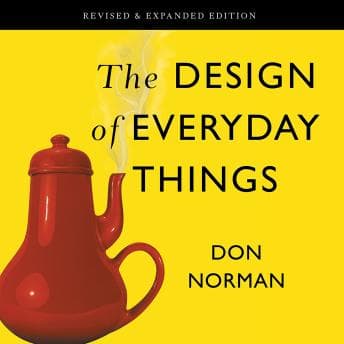

Most people think they're stupid when they can't figure out how to work a hotel shower. Don Norman proves the shower is stupid. That's the premise here.
I picked this up because I'm tired of seeing pitch decks for apps that require a PhD to navigate. I thought, "Let's go back to basics." And honestly, this book is the holy grail of product philosophy. But—and this is a big but—listening to it was an exercise in irony.
The Ghost of Koreatown Dry Cleaners
I grew up watching my parents wrestle with industrial machinery that had zero user empathy. The dry cleaning press had three red buttons. One started steam, one stopped it, and one was an emergency shut-off. They looked exactly the same. My dad operated that thing on pure muscle memory and anxiety.
Listening to Norman break down "affordances" and "signifiers," I realized my parents weren't just hardworking; they were battling hostile design daily. Norman argues that if a user makes an error, it's not a user error—it's a design error.
(I tried explaining this to a founder last week who blamed his customers for "not getting" his crypto-wallet flow. He didn't appreciate the feedback. I sent him this book.)
I wish I'd also sent him Getting to Yes—because if you can't design for humans, at least learn to negotiate with them.
The content is gold. It shifts your brain. You stop blaming yourself for pushing a door that says "pull" and start blaming the architect. It's liberating. It's also infuriating, because once you see bad design, you see it everywhere. My wife Jenny banned me from critiquing our toaster, but seriously, why is the cancel button on the back?
The Ironic Glitch in the Matrix
Here's where the ROI calculation gets tricky. This is a book about creating smooth, frustration-free experiences.
The audiobook production? Not smooth.
Neil Hellegers is actually a solid narrator. He's got that clear, warm, "I'm a smart professor but I won't fail you" vibe. He handles the technical jargon without sounding like a robot. But the editing is... weird.
Throughout the recording, the ends of sentences sometimes speed up or get clipped off. It's like the editor was in a rush to get to happy hour. For a book that literally preaches about feedback and consistency, having audio glitches is rich. It's a usability issue in a product about usability.
I usually listen at 2.0x speed. I had to dial it back to 1.25x just to make sure I wasn't imagining the tempo shifts. It's not unlistenable—the ideas still land—but it's sloppy. David Park does not approve of sloppy.
Who Gets Value Here (And Who Doesn't)
If you build products, design interfaces, or sell anything to humans, this is required reading. You need to understand the "Norman Door." Skip it if you're looking for a polished audio experience or need visual diagrams to learn—the concepts are easier to absorb in print.
The Bottom Line Over Coffee
Look, the concepts in here are non-negotiable for anyone in business. But this is one of those rare cases where I might tell you to grab the physical copy. Partly because design is visual (hard to visualize a teapot layout while driving on the 405), and partly because the audio editing might drive you crazy if you're as neurotic as I am.
If you do listen, treat it like a podcast you're eavesdropping on. The wisdom is there, just ignore the static. And please, for the love of God, label your buttons.