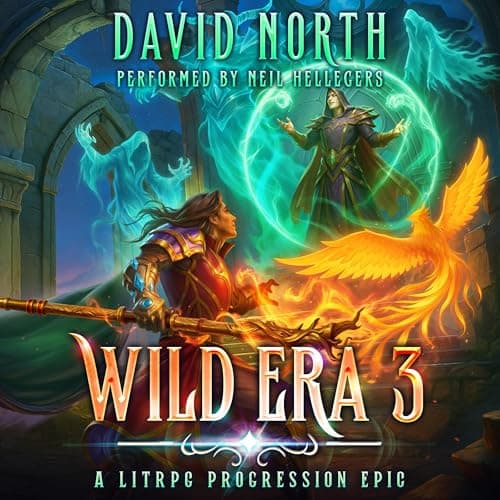

Book three of a LitRPG progression series is where you find out if the author actually has a plan or if they're just generating stat blocks into the void. Wild Era 3 lands somewhere in between, and that ambiguity is both its charm and its frustration.
I was shelving returns at the library on a slow Tuesday afternoon — one of those gray Oregon days where the fluorescent lights feel actively hostile — and I had this running through my earbuds. Kelin Wildfire's journey into the desert Empire of Sarathia, with its undead-tainted sands and dark rituals, paired surprisingly well with the quiet monotony of alphabetizing donated paperbacks. The worldbuilding here is genuinely interesting. David North has built something with Celadon that feels lived-in after three books, and the 5,000-year time jump from the Aster Fall universe gives it this sense of deep archaeological history that I'm a sucker for. Ancient powers corrupting a desert kingdom? Undead flowing endlessly from the sands? That's the kind of imagery that makes my horror-loving brain light up, even wrapped in LitRPG mechanics.
That same pull toward ancient corruption and creeping dread is what drew me to Visions of Flesh and Blood, though that one leans harder into the body horror end of the spectrum.When the Grind Becomes the Monster
Here's where I got conflicted. The progression elements — levels, classes, crafting, rare evolutions — are the backbone of this genre, and North clearly loves them. Kelin's goal of becoming the Sovereign of Souls and Lord of Reincarnation is a genuinely cool aspiration for a reborn Archmage. But there are stretches where the narrative reads like someone explaining their character build in exhaustive detail, and those sections hit different in audio. On the page, you can skim a stat block. In your ears, at nearly 14 hours, you're along for every single number. Some of those middle hours felt less like storytelling and more like watching someone optimize a spreadsheet — impressive, sure, but not exactly the kind of tension that keeps your pulse up.
The Sarathia arc is where things get genuinely good. Dark rituals, undead enemies, the sense that Kelin is walking into something ancient and hostile — North writes action sequences that have real momentum, and this is where the audiobook format earns its keep.
Neil Hellegers Steps Into Someone Else's Shoes
Let's talk about the narrator situation, because it's the elephant in the room for series listeners. Neil Hellegers is not the original narrator, and that transition is... noticeable. The first few chapters, I was adjusting, trying to map these new vocal interpretations onto characters I'd already built mental voices for. It's like when a TV show recasts a supporting character between seasons — your brain resists for a while.
But Hellegers settles in. His fight scene narration has real energy, and he handles the scope of North's world without sounding like he's reading a textbook. By the time Kelin reaches Sarathia, I'd stopped comparing and started just listening. That's the mark of a narrator who commits to the material even when it's dense with system mechanics and world lore. And that commitment is rare — especially when you're inheriting someone else's characters.
I do wish there were more distinct vocal signatures for the supporting cast. With a world this populated, some characters blurred together in audio, and a 14-hour listen demands that kind of differentiation to keep you anchored.
The Editing Problem Nobody Wants to Talk About
There's a lack of polish here that's hard to ignore. Some passages feel like they could've used another editing pass — repetitive phrasing, scenes that run longer than they need to, moments where the pacing sags under the weight of its own detail. In print, this is a minor annoyance. In audio, where you can't easily skip back or skim, it compounds. Every unnecessary paragraph is another minute of your life, and at 13 hours and 46 minutes, those minutes add up.
This is a problem I see constantly in LitRPG — the genre rewards volume and series velocity, which sometimes comes at the cost of tight editing. North has interesting ideas and a world worth exploring, but Wild Era 3 would've been sharper at 11 hours.
Who Gets Burned and Who Gets Lit (And Who Should Skip)
If you're already invested in Kelin's story and you enjoy the mechanical satisfaction of watching a character optimize their build across centuries, this delivers exactly what you want. The Sarathia desert arc is the strongest section, and the undead elements scratch an itch that most LitRPG doesn't even try to reach. Skip this one if you bounced off the earlier books or find detailed progression mechanics tedious in audio form — book three won't convert you. And if you need tight pacing over sprawling worldbuilding, the mid-section drag will test your patience.
Shelving This One Between "Impressed" and "Impatient"
I listened in the dark on a late shift at the library, the last hour playing while I locked up and walked to my car through empty streets. The Sarathia sections — the undead, the ancient corruption, the sense of something vast and hostile waiting in the sand — those hit right. My podcast listeners who dig LitRPG with genuine dark fantasy undertones are going to want this one. But I kept wishing North would trust his best instincts more and his stat sheets less. The bones of something great are here. They just need less meat on them.