๐ŸŽง
AudiobookSoul
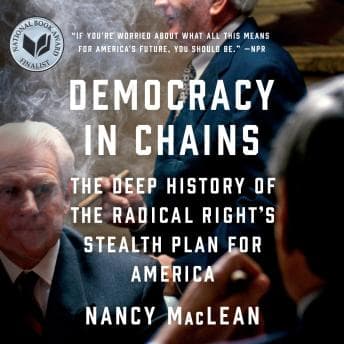
Democracy in Chains: The Deep History of the Radical Right's Stealth Plan for America audiobook cover

Democracy in Chains: The Deep History of the Radical Right's Stealth Plan for America โ€” Sixty Years of Ideological Warfare Documented

by Nancy MacLean๐ŸŽคNarrated by Bernadette Dunne
๐Ÿ”ต Worth Credit
โœ๏ธ 4.0 Editorial
๐ŸŽค 4.0 Narration
11h 31m
๐ŸŽ–๏ธ

Mission Brief

Sixty Years of Ideological Warfare Documented

  • โ€ขMission Pace: Dense academic material that rewards focused attention at 1.25x speed
  • โ€ขComms Quality: Dunne's measured, slightly scratchy delivery keeps explosive material from becoming shrill
  • โ€ขMission Value: Provides intellectual framework for understanding current American political strategies
  • โ€ขFinal Assessment: Worth a Credit

Is this for you?

โœ…Pick this if: you want to understand the intellectual architecture behind current American political strategies ยท you appreciate deep archival research and don't mind a clear authorial perspective ยท you enjoy cerebral investigative history and can give it focused sustained attention
โŒSkip if: you need balanced both-sides framing or expect a neutral moderating tone ยท you need narrative action to stay engaged or mostly listen while distracted ยท you prefer accessible summaries over dense academic material with primary sources
๐Ÿ“šBest for fans of: Dark Money by Jane Mayer, The Wrecking Crew by Thomas Frank, A Promised Land by Barack Obama
Read Time4 min read
Duration11h 31m
Best Speed:1.25x recommended
Your rating?
James Cooper, audiobook curator
Reviewed byJames Cooper

Retired Colonel, 25 years Army. Cried during The Things They Carried.

๐ŸŽง Listens in truck between meetings, looks for meticulous research connecting historical dots, zero tolerance for sloppy investigative work.

Last updated:

Share:

"The first thing a man will do for his ideals is lie." That's not from the book, but it kept running through my head around hour six. MacLean's tracing the intellectual genealogy of James McGill Buchanan - a Nobel laureate most Americans have never heard of - and I'm sitting in my truck outside a client's Houston office, engine running for the AC, completely forgetting I have a meeting in ten minutes. Let me cut to the chase: this is investigative history that reads like an intelligence briefing. MacLean spent a decade in the archives, and it shows. She's connecting dots between a Virginia economist's response to Brown v. Board of Education in 1956 and the policy playbook being executed in state legislatures right now. For another deep dive into how American institutions evolved around race and power, [Promised Land](/reviews/promised-land) covers similar ground from a different angle. Whether you buy her conclusions or not, the documentation is substantial. ## The Operational History You Never Got Here's what grabbed me: Buchanan wasn't some fringe crank. He built an academic infrastructure - think tanks, university centers, training programs - specifically designed to reshape how Americans think about government. MacLean traces how his ideas about "public choice theory" became the intellectual ammunition for everything from union-busting to voter ID laws. The strategy wasn't to win arguments. It was to change the rules so you didn't have to. I've seen this playbook in other contexts. You don't take the hill by charging up the middle. You flank. You dig in. You wait. Buchanan and later Charles Koch understood this was a generational campaign. MacLean documents the patience involved - sixty years of institution-building, funding obscure academic programs, placing graduates in key positions. [American Religious History](/reviews/american-religious-history) traces a similar pattern of institutional development, though in a very different context. It's actually impressive from a purely tactical standpoint, even if you find the objectives troubling. The author clearly did her homework. She got access to Buchanan's papers at George Mason University before they were restricted, and she uses internal memos and correspondence to show the gap between public messaging and private strategy. That's the kind of primary source work that makes a historian's argument credible. ## Where It Lost Me - And Where It Didn't Look, MacLean has a perspective. She's not pretending otherwise. The book's subtitle includes "Stealth Plan" - that's not neutral language. Some critics have accused her of overreach, of attributing too much coordination to what might be parallel evolution of ideas. Fair enough. But here's the thing: I've worked in environments where coordination happens without explicit orders. You establish doctrine, you train people in that doctrine, and then you don't need to micromanage. They know what to do. MacLean's argument that Buchanan created an ideological framework that operates this way isn't actually that far-fetched to anyone who's led organizations. What I would've liked more of: the opposition. MacLean gives us the offensive playbook but not much about counter-operations. Why did the other side lose ground for so long? That's a book I'd read next. ## Dunne's Restraint Works Here Bernadette Dunne narrates with exactly the right temperature. This material could easily become shrill in the wrong hands - it's about power, race, money, democracy itself. But Dunne keeps it measured. Her voice has a slight scratch to it that actually works well for what is essentially an 11-hour briefing on ideological warfare. She's not performing; she's reporting. At 1.25x, the pacing felt right. Dunne's natural cadence is deliberate, which serves the dense material, but I needed that slight acceleration to stay locked in during the more academic sections. ## Who Should Deploy This If you want to understand the intellectual architecture behind current American politics - not just the personalities, but the ideas - this is worth your time. It's not beach reading. It's the kind of book that makes you want to take notes, look up names, follow the money. Skip it if you're looking for balance. MacLean is making a case, not moderating a debate. Also skip if you need action to stay engaged - this is cerebral throughout. No car chases. No explosions. Linda would've bailed by hour two. For those of us who've spent careers studying how organizations really work - the doctrine, the training pipelines, the long-game thinking - this book offers a civilian education in how ideas become power. Agree with MacLean's politics or not, she's documented something real. ## Mission Debrief Ranger slept through most of this one, which tracks. But I'm still thinking about it a week later, which is the actual test. MacLean may overstate some connections, but she's identified a campaign that most Americans don't know exists. That's valuable intelligence, whatever you do with it.

After-Action Report ๐Ÿ“‹

Audio production quality notes that may affect your listening experience

๐ŸŽ™๏ธ

Read by a single narrator throughout the entire audiobook.

๐Ÿง 

Intellectually stimulating content requiring focused attention.

๐Ÿข
๐Ÿ“ˆ

Quick Info

Release Date:June 13, 2017
Duration:11h 31m
Language:English
Best Speed:1.25x
Audio Code:58694736

About the Narrator

Bernadette Dunne

Bernadette Dunne is an award-winning audiobook narrator with over 20 years of experience. She has narrated a wide range of genres including mystery, fiction, biographies, and memoirs, and has been recognized for her work with numerous AudioFile Earphones Awards and multiple Audie Award nominations.

19 books
4.0 rating

Enjoyed this review? Rate it!

๐Ÿ“ฌ

Get Weekly Audiobook Picks

Join listeners getting honest reviews from our curators every Monday. No spam. Unsubscribe anytime.

Subscribe on Substack