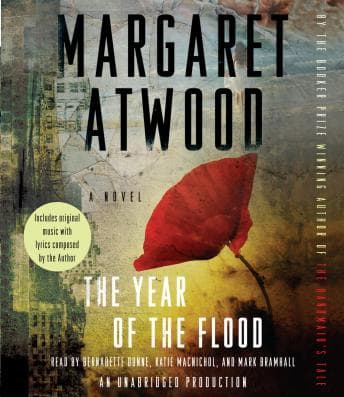

Look, I'm just gonna say it: Margaret Atwood builds worlds like Sanderson builds magic systems. The Year of the Flood is the kind of speculative fiction that makes you want to take notes - not because you're confused, but because every little detail clicks into place like a D&D campaign designed by someone who actually reads ecology textbooks for fun.
I came to this after devouring Oryx and Crake, and honestly? This might be the better entry point. Atwood pulls the camera back from Jimmy's perspective and hands us Toby and Ren - two survivors of the Waterless Flood who experienced the apocalypse from completely different angles. Toby's holed up in a spa eating cucumber face masks (yes, really), and Ren's trapped in a high-end strip club called Scales and Tails. The world-building here is chef's kiss. Gene-spliced Mo'hair sheep with human hair. Pigs with human brain tissue. Lion-lamb hybrids called liobams. It's body horror meets environmental collapse meets religious satire, and I was absolutely here for all of it.
The God's Gardeners Hit Different
The genius move is centering the God's Gardeners - this eco-religious cult that's somehow both completely bonkers and the only people who saw the apocalypse coming. They've got feast days named after Rachel Carson and Dian Fossey. They sing hymns about composting. It sounds like parody, but Atwood plays it straight enough that you start thinking maybe they've got a point. The flashback structure bounces between pre-flood and post-flood, and while some folks found the pacing slow at the start, I was too busy absorbing the world to notice. (This is the same brain that reads Stormlight Archive prologues three times, so your mileage may vary.)
The three-narrator setup is ambitious. Bernadette Dunne handles Toby with this weathered, survivor's edge that fits perfectly. Katie MacNichol takes Ren, and there's an authenticity to how she captures someone who's been through the Gardener cult, escaped to the corporate world, and ended up dancing for rich people in a quarantine bubble. Mark Bramhall does the Adam One sermons and - here's where it gets interesting - the songs.
About Those Hymns, Though
Okay, so Atwood wrote actual hymns for the God's Gardeners. In the book, they're printed lyrics. In the audiobook, someone decided to set them to music and have Bramhall perform them. And look, this is where the audiobook community splits hard. Some people love it - the songs add atmosphere, make the cult feel real, give you that immersive religious experience vibe. Other people? Absolutely hated it. Found it distracting, thought the musical choices were weird, wanted to skip past them.
I'm... somewhere in the middle? Bramhall commits to the bit, and I respect that. But a few of the musical arrangements felt like they belonged in a different production entirely. If you're the type who skips songs in fantasy audiobooks (you know who you are), you might find yourself reaching for that 30-second skip button.
The narration has a few rough patches beyond the music. There's a mispronunciation of "CorpSeCorps" - the private security force that basically runs everything - that apparently drove some listeners up the wall. I noticed it, moved on, but I get why it bothers people when a key worldbuilding term gets mangled repeatedly over 14 hours.
Who Should Queue This Up (And Who Should Skip)
Here's the thing: this isn't fast-paced. It's not action-driven. It's Atwood doing what Atwood does - building a satirical mirror of our world, populating it with deeply human characters, and letting the horror creep in through the details rather than the plot beats. That same meditative, detail-oriented approach is what makes Siddhartha work - it's all about the internal journey, not the action beats. If you want explosions and chase scenes, this ain't it. If you want to spend 14 hours in a meticulously constructed dystopia that feels uncomfortably plausible? Strap in. Skip it if slow-burn literary sci-fi makes you antsy, or if sung hymns in your audiobooks are a dealbreaker.
The character work is stellar. Toby's backstory - escaping an abusive situation, finding the Gardeners, becoming their beekeeper and eventually their medic - has real weight. Ren's journey through the corporate world of the Compounds, her relationship with Jimmy (yes, THAT Jimmy from Oryx and Crake), and her eventual imprisonment in Scales and Tails during the plague creates genuine tension. You care about these people. You want them to survive.
(I listened to most of this while "working on my thesis" which is code for avoiding my thesis while technically being at my computer. Dr. Patel would not approve.)
The multi-narrator approach mostly works, though I've seen some folks argue the casting wasn't quite right for the main characters. Personally, I thought Dunne and MacNichol brought distinct enough voices that switching between them never felt jarring. It's not full-cast production, but it's more than a single narrator trying to do everything.
Roll for Replayability
Yeah, actually - I'd listen again. There's enough layered into this world that a second pass would probably catch things I missed. And I need to hit MaddAddam to complete the trilogy - this is one of those series where the pieces fit together in ways that reward the full commitment. If you're coming in fresh, you could start here or with Oryx and Crake. Different entry points, same devastated world.
Just... maybe go in knowing the songs are there. Decide in advance if you're gonna embrace them or skip them. And don't let a mispronounced security force name ruin your apocalypse.