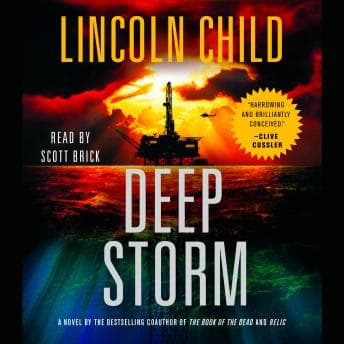

I went into this one expecting Crichton. Lincoln Child, underwater research facility, ancient mystery, mysterious illness spreading through the crew. It has that techno-thriller DNA stamped all over it. And look, sometimes you want exactly that. Sometimes you're grading forty-seven essays on The Great Gatsby at 11 PM and you need something that doesn't require you to parse Faulknerian syntax.
Deep Storm delivered. Mostly.
The Atlantis Bait-and-Switch
Here's what Child does well: he knows the Atlantis hook is just that—a hook. Dr. Peter Crane gets summoned to this oil rig that's actually a cover for a massive underwater excavation project, supposedly unearthing the remains of Atlantis itself. But Crane's a former naval doctor, not an archaeologist. He's there because people are getting sick. Headaches, paranoia, violent outbursts. The kind of symptoms that make you think "environmental contamination" before you think "ancient curse."
The reveal—that something else entirely is going on beneath the ocean floor—isn't exactly shocking if you've read any thriller in the last three decades. But Child builds the paranoia effectively. The claustrophobic setting of Deep Storm, two miles underwater, with its sterile corridors and classified compartments and layers of security clearance, creates genuine unease. Wolf Hunters had that same claustrophobic tension, though it traded underwater pressure for frozen tundra. This reminds me of what Hemingway said about the iceberg theory—what's beneath the surface matters more than what's visible. Child literalizes that metaphor, perhaps too obviously, but it works.
Scott Brick: Steady Hand, Maybe Too Steady
Scott Brick is one of those narrators who splits listeners right down the middle. I've heard him do brilliant work—The Passage comes to mind, where his measured approach matched the apocalyptic dread perfectly. Here? It's more complicated.
Brick has impeccable diction. Always knew who was speaking, even when Child throws a dozen scientists and military personnel at you in rapid succession. His voice carries what I'd call equanimity—a steadiness that keeps the complex plot clear when things start spiraling into conspiracy territory.
But here's the thing. Deep Storm has action sequences. Chases. Confrontations. Moments where characters should be panicking. And Brick... doesn't quite get there. He reads a tense escape scene with the same measured cadence as a character reviewing lab results. It's like watching a conductor who refuses to let the orchestra crescendo. The drama is in the text, but the performance stays at a steady mezzo-forte.
For me, listening while walking the lakefront on a gray November morning, this worked. The lake was choppy, the wind was cutting, and Brick's voice was this anchor of calm. But I can see how someone listening during a workout or commute might find it exhausting in a strange way—all that tension in the story with nowhere to go in the delivery.
Where the Hull Springs Leaks
The prose here isn't asking to be savored—it's functional, propulsive, designed to move you from revelation to revelation. Which is fine. Not every book needs to be Middlemarch. (Principal Martinez, if you're reading this, I was definitely paying attention in that meeting about curriculum standards. I wasn't listening to Middlemarch.)
The problem is the ending. Without spoiling it—the final revelations feel like Child painted himself into a corner and had to make a running leap to get out. The setup is meticulous, the middle is tense, and then the conclusion asks you to accept about three impossible things before breakfast. My students would call it "a reach." They'd be right.
And there are clunky moments throughout. Exposition dumps disguised as character dialogue. Scientists explaining things to other scientists that both would already know. It's the thriller equivalent of having characters say "As you know, Bob..." Child's usually better than this.
Who Should Take the Plunge (And Who Should Stay on Dry Land)
If you loved Crichton's Sphere, this is its spiritual successor—minus the philosophical depth, plus some extra conspiracy seasoning. Perfect for listeners who want atmosphere over action, who don't mind a narrator that stays cool when things heat up. Skip it if you need your thrillers to actually *feel* thrilling in the delivery, or if predictable twists make you twitchy.
Final Grade from the Teacher's Desk
Thirteen hours is a commitment. For a thriller with a predictable twist and a narrator who won't match your heart rate, that's asking a lot. But here's what I kept coming back to: the atmosphere. Child understands that the best part of an underwater thriller isn't the monster or the conspiracy—it's the weight of all that water above you. The knowledge that you're in a pressurized bubble surrounded by crushing darkness.
Deep Storm isn't going to change your life. It's not going to make you think differently about the human condition or the nature of civilization. But it's a competent, atmospheric thriller that knows exactly what it is.
I finished it. That's more than I can say for the last three "literary thrillers" I attempted. Sometimes you need a book that's just a good story, told well enough, that gets you through a stack of essays about green lights and American dreams.
Worth pausing the faculty meeting for. Just maybe not worth full credit.