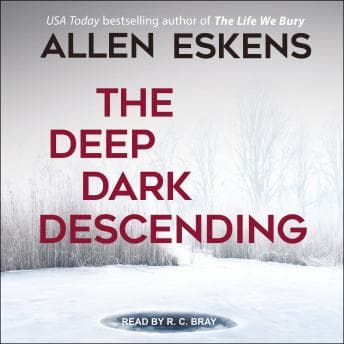

"Most of his life he'd thought of himself as a decent man."
That line hit me somewhere around hour two, sitting in the hospital break room at 4 AM with the lights dimmed and my coffee going cold. The unit was quiet — knock on wood — and I had my earbuds in, and R.C. Bray just delivered it like a man staring into a mirror and not recognizing what's looking back.
This book wrecked me in the best way.
A Cop on a Frozen Lake With Nothing Left to Lose
Allen Eskens does something gutsy here. He takes a homicide detective, Max Rupert, and strips away every guardrail — the badge, the oath, the moral framework that keeps good people from becoming the monsters they hunt. Max's wife didn't die in a random hit and run. She was murdered. And when Max finds out, the question stops being "who did this" and becomes "what am I willing to become to make them pay."
The frozen lake setting near the Canadian border isn't just atmosphere. It's a character. Eskens uses the cold, the isolation, the absolute nowhere-to-hide quality of ice and darkness as a physical manifestation of Max's psychological state. You're out there with him. You feel it. As someone who's actually worked a code, I know what it looks like when a person crosses a threshold they can't come back from. I've seen the moment in someone's eyes when the fight goes out — or when something worse floods in. Eskens writes that moment with the precision of someone who spent 25 years in criminal defense. The procedural details don't feel googled. They feel lived in.
If you've read the earlier Max Rupert books — particularly The Heavens May Fall — this one is a different animal. Less procedural complexity, more psychological free fall. That trade-off won't work for everyone, but for me it was the right call. This story didn't need a complicated case. It needed a complicated man.
R.C. Bray Was Born to Narrate This Specific Darkness
I've listened to Bray in sci-fi, in action-heavy stuff, and he's always solid. But this is something else. His Max Rupert is exhausted in a way that goes beyond physical fatigue — it's the voice of a man who's been carrying grief like a second skeleton inside his body. Bray doesn't go big and dramatic. He goes quiet. He lets the pauses do the work. When Max is wrestling with whether to cross that final line, Bray's delivery is so controlled, so tight, that you can hear the restraint cracking at the edges.
The character differentiation is subtle — no cartoon voices — but you always know who's talking. It's in the weight of the words, the cadence shifts. Max sounds different when he's being a cop versus when he's being a widower, and Bray catches both without making it feel like a performance. It just sounds like a man with two selves trying to figure out which one survives.
Compare this to something like the Bosch audiobooks, which I also love. Bosch is dark, sure, but there's always the procedural architecture holding everything together, giving you handrails. Deep Dark Descending throws that structure out. This isn't a whodunit with a satisfying arrest at the end. This is a man alone on ice deciding if he's going to commit murder. Le Carré walks the same tightrope in Legacy of Spies — completely different world, but the same queasy question at the center: what does a decent person become when the institution that gave their choices meaning finally asks them to answer for those choices? The tension is almost entirely internal, which is a harder thing to pull off in audio — and both Eskens and Bray pull it off.
Not for the Faint of Heart. And That's the Point.
Some folks found this too dark. I get it. If you need a cozy mystery or a thriller with a neat bow, this is not your book. The grief is heavy. The violence is real. Max's descent isn't glamorized — it's ugly and sad and deeply human.
But here's what elevates this beyond dark-for-the-sake-of-dark: Eskens makes you complicit. You're rooting for Max to get his revenge. And then you catch yourself and think — wait. Do I really want that? What does it say about me that I'm hoping he crosses that line?
Carlos asked why I was crying in the car. I blamed allergies. In July. In Phoenix. He didn't buy it.
Who Needs This in Their Ears
If you love character-driven crime fiction where the real mystery is what a person is capable of — yes. If you've done Dennis Lehane, Tana French, the darker corners of detective fiction where nobody comes out clean — yes. If you want something for a quiet night when you don't mind sitting with uncomfortable questions — absolutely.
Skip it if you need your protagonists to stay on the right side of the line. Skip it if dark means too dark for you. No judgment.
At 8 hours and change, it doesn't overstay or rush. Eskens knows when to let a scene breathe on that frozen lake and when to tighten the screws until you forget you're supposed to be breathing too.
Night Shift Approved — Bring a Blanket
I finished this three days ago and I'm still thinking about that ice. Still thinking about what Max chose. Still not sure if I agree with it.
That's the sign of a book that did its job.