
I honestly expected to be done with this series by now.
Usually, by Book 4, the "survival against impossible odds" algorithm gets stuck in a loop. You know the drill: heroes find safety, safety fails, heroes run, repeat. I was ready to archive this whole storyline and move on to something denser. But then Nicholas Sansbury Smith decided to swap the physics engine entirely.
We aren't falling out of the sky anymore. We're on a boat. A radioactive, monster-infested ocean. And somehow, that one variable change fixed the latency issues I was feeling with the plot.
TRADING ALTITUDE FOR SALTWATER
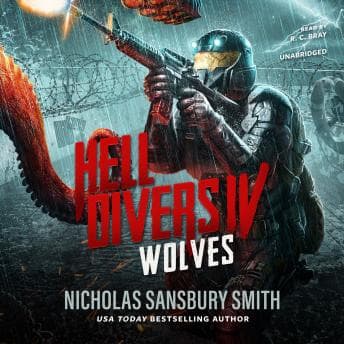
Here's the thing about Hell Divers: it's always been about verticality. Falling, climbing, flying. Wolves flips the axis. X (Xavier Rodriguez) is back—because of course he is—but now he's leading a crew on the Sea Wolf to find the Metal Islands.
(Yes, the "Metal Islands" sounds like a level in a video game, but go with it.)
The shift from airships to the open sea changes the tension. On the airships, the threat was gravity and lightning. On the water? It's storms, mutant sea monsters, and the Cazadores (cannibals, naturally). It feels claustrophobic in a different way. You can't just dive away from your problems anymore.
I listened to the first three hours while debugging a nasty race condition at work—don't tell my manager—and I barely noticed the time passing. The pacing is tight. It doesn't meander. It knows exactly what it is: a high-octane thriller that wants to keep your heart rate at cardio levels.
R.C. BRAY COULD READ JIRA TICKETS AND I'D GIVE IT 5 STARS
He is my spirit narrator.
If you haven't heard Bray before, you're missing out. The man doesn't just read; he grinds the words out like he's been smoking unfiltered cigarettes since the apocalypse started. He brought that same grit to Mysterious Island, though that survival story trades radioactive oceans for Victorian-era resourcefulness. His voice for X is just... tired. But the kind of tired that's still dangerous. It fits perfectly.
What really impressed me this time—and this is super nerdy, I know—is how he handles the altered place names. The world has changed, language has drifted, and Bray nails the specific pronunciations of these twisted locations without stumbling. It adds this layer of immersion that a lesser narrator would've totally fumbled. He makes the ridiculous sound plausible.
WHEN THE SCRIPT NEEDS A PATCH
Okay, I have to flag one bug.
The motto. "We dive so humanity survives."
We get it. Seriously. It's repeated enough that it starts to feel like a corporate mission statement plastered on the breakroom wall. Every time a character said it with grave intensity, I rolled my eyes a little. It's cheesy. It's a bit much.
But look, you don't listen to Hell Divers for subtle, nuanced prose about the human condition. You listen to it because you want to see X fight a mutant shark while R.C. Bray growls in your ear. On that front? The ROI is massive.
WHO SHOULD QUEUE THIS UP (AND WHO SHOULDN'T)
If you liked the first three, this breathes new life into the code. If you dropped off after Book 2, this is worth a git pull to get back up to speed. But if you need literary prose or hate repetitive mottos, skip it—this isn't trying to be that.
SHIPPING TO PRODUCTION
I finished this in about four commutes (SF to Mountain View, the eternal struggle). It's perfect for that 6 AM brain fog when you want to be awake but aren't ready to process complex systems architecture.