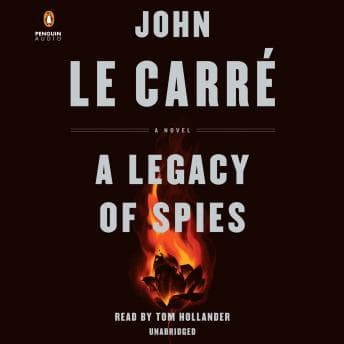

Look, I'll be honest - I went into this one skeptical. Everyone kept telling me this was le Carré's triumphant return to Smiley after twenty-five years, and usually when authors go back to old characters that long after, it's... not great. Like watching your favorite band do a reunion tour and realizing maybe some things should stay in the past. I had that same skepticism going into Let Me Go, another thriller that surprised me by actually delivering.
I was wrong. So wrong. And I'm woman enough to admit it.
The Voice That Made Me Miss My Exit
Tom Hollander. This man. I've listened to a lot of audiobooks during my 45-minute post-shift drives, and I can count on one hand the narrators who've made me sit in my driveway, engine running, refusing to go inside until a chapter ends. Hollander's now on that list.
His voice has this quality - warm but coiled, like he knows something terrible is coming but he's going to take his time getting there. The pacing is deliberate in a way that would feel slow in lesser hands, but here? It builds tension like an IV drip of anxiety. Every pause means something. I found myself holding my breath during interrogation scenes, which is not ideal when you're navigating Phoenix traffic at 7 AM after a twelve-hour shift.
Some listeners apparently missed Michael Jayston, who narrated the earlier Smiley books. I get it - there's something about consistency in a series. But Hollander brings something different, something that fits this story's particular mood of looking backward while being dragged into the present.
When the Past Comes Calling (And It Always Does)
The story itself hit different for me. Peter Guillam, this old spy living out his retirement in France, gets summoned back to London because operations from decades ago are being scrutinized by people who weren't even alive during the Cold War. They want accountability. They want explanations. They want to judge decisions made in impossible circumstances by people who've never had to make them.
As someone who's actually worked a code on a patient who came in from a car accident caused by a drunk driver - and then had to explain every decision to a review board months later - I felt this in my bones. The way le Carré captures that sensation of having your past picked apart by people who have the luxury of hindsight and no skin in the game? Accurate. Painfully accurate.
The narrative weaves between past and present, which could've been confusing, but Hollander handles the transitions so smoothly you barely notice. One moment you're in 1960s Berlin, the next you're in a modern London office, and it all feels like one continuous story of consequences catching up.
The Institutional Stuff Is Accurate. Finally.
Okay, there's not a lot of medicine in a spy novel - I know. But le Carré gets the bureaucracy right. The institutional memory. The way organizations protect themselves at the expense of individuals. The way younger generations look at older ones and think they could've done better, would've been more ethical, without understanding what it was actually like.
I didn't yell at my dashboard once during this one. That's high praise. Unlike Giving Up The Ghost, which had me screaming about medical procedure inaccuracies for three straight minutes.
Carlos asked why I was crying in the car after one particular section near the end. I blamed allergies. It was not allergies. Le Carré does this thing where he makes you feel the weight of a lifetime of choices, good and bad, and how they all accumulate into something you have to carry. At 3 AM when the unit is quiet and I'm charting and thinking about patients we lost and patients we saved and whether I could've done anything different - yeah. This book understands that feeling.
Who Should Listen (And Who Should Skip)
This is perfect for that post-shift decompression if you want something that engages your brain without requiring you to remember seventeen character names. It's complex, sure, but it's the kind of complex that rewards attention rather than punishing distraction.
Best for: Anyone who's ever had to justify past decisions to people who weren't there. Fans of slow-burn espionage. People who appreciate moral ambiguity instead of clear heroes and villains. Commuters who want something meaty.
Skip if: You need action every five minutes. You've never read le Carré and want to start somewhere - this really benefits from knowing the earlier books. You want easy answers about right and wrong.
My mom would love this. She still thinks I should've been a doctor, but she also loves a good spy story. I'm lending her my Audible login.
Night shift approved. Driveway sitting approved. Unexplained car crying approved.