
Look, I'm going to be honest with you. I almost didn't finish this one. Not because it's bad - it's actually pretty solid - but because by hour three I was already mentally reorganizing how I make decisions at work, and I needed to stop and actually implement something before the next framework showed up.
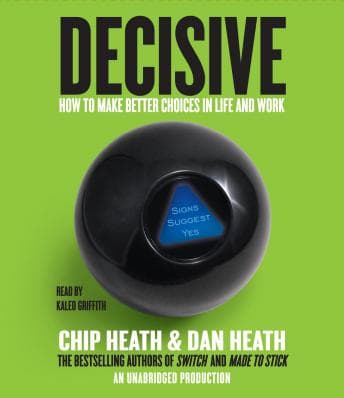
That's the thing about the Heath brothers. They're efficient. They respect your time. And in a genre where most authors could've said their piece in a blog post but stretched it into eight hours of audiobook padding, Decisive actually earns most of its nine-hour runtime. Most. We'll get to that.
The WRAP Framework Actually Works (Unlike Most Acronyms)
The core of this book is their WRAP process: Widen your options, Reality-test your assumptions, Attain distance before deciding, Prepare to be wrong. Yes, it's an acronym. Yes, I usually hate those. But here's the thing - I've already used it twice with clients this month.
The Heaths do what they do best: take psychological research that academics have buried in jargon and make it actionable. They talk about "narrow framing" - how we trap ourselves into yes/no decisions when there are actually seventeen other options we haven't considered. This is what my parents did instinctively when they were deciding whether to expand the dry cleaning business. They didn't ask "should we open a second location?" They asked "what are all the ways we could grow?" Now it has a TED talk.
The examples range from a CEO's catastrophic acquisition (Quaker buying Snapple - ouch) to how a rock band decides on setlists. Some land better than others. The business cases hit home for me. The personal decision examples? Jenny would say I'm being harsh. Jenny is right. But they felt a little... manufactured.
Kaleo Griffith Gets Out of the Way (In a Good Way)
I couldn't find much about Griffith online, but based on this performance, he understands something crucial about business audiobooks: the narrator's job is to disappear. He reads clean, maintains good energy without being performative, and - this is key - doesn't try to "act" the examples. When he's describing a case study, he's telling you about it, not performing a one-man show.
The pacing is solid. I listened at 1.5x (I know, I know, slower than my usual 2.0x) because I actually wanted to absorb the frameworks. At 2.0x, I was missing nuances. That's actually a compliment to the content density.
Where It Drags (And What You Can Skip)
Skip to the chapter summaries if you're in a hurry. Each section ends with a tight recap that captures 80% of the value. The Heaths are good about this - they're not hiding the ball.
The weakest sections are when they venture into personal relationship decisions. The business applications are airtight. The "should I break up with my partner" stuff feels like it was added because someone told them the book needed broader appeal. I've seen this fail at three different companies - trying to be everything to everyone. The Heaths are better than this.
Also, and this is minor, but around hour six there's a stretch where the examples start to blur together. I was driving from San Jose to LA and genuinely lost track of which company was making which mistake. Could've been tighter.
The Real Value Proposition
Here's what I tell my clients: this book is worth it for two concepts alone. First, the "10/10/10" framework - how will you feel about this decision in 10 minutes, 10 months, and 10 years? Simple. Powerful. I've used it in three board meetings. Second, the idea of "ooch" - running small experiments before committing to big decisions. It's the kind of actionable framework that Awaken the Giant Within promises but rarely delivers with this level of specificity. Stop agonizing, start testing.
The 10/10/10 and ooch concepts are worth the listen alone. The other 7 hours? Diminishing returns. But unlike most business books, this one has maybe three or four key takeaways that are genuinely useful, which puts it in the top 10% of my Audible library.
Who's This Actually For?
For business folks who make decisions under pressure, absolutely. For anyone who's ever spent three weeks agonizing over a decision that deserved three hours of thought, yes. For people looking for deep philosophical frameworks about free will and decision theory? Skip it. This is practical, not profound.
Park's Bottom Line
My 2.0x speed couldn't save the slower sections, but at 1.5x, this was a solid investment of commute time. The Heaths continue to be one of the few business authors who actually seem to have read their own research. That bar is lower than you'd think.