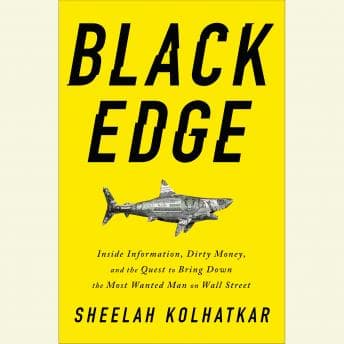

"The edge is everything."
Somewhere around hour three, that phrase stopped being abstract Wall Street jargon and started feeling like a diagnosis. I was on a red-eye to Chicago, couldn't sleep, and Kolhatkar had me genuinely angry about a hedge fund I'd never heard of until two days prior. That's good journalism.
Here's the bottom line: *Black Edge* is the business book I wish existed when I was at McKinsey, watching partners dance around the question of where "aggressive research" ends and crime begins. Kolhatkar—herself a former hedge fund analyst—knows exactly where those lines blur, and she's not interested in letting anyone off easy.
The SAC Capital Playbook (And Why It Matters)
Steven Cohen built a $15 billion empire on being right more often than probability should allow. The government spent seven years trying to prove what everyone on Wall Street whispered: that SAC's edge wasn't genius—it was inside information, systematically harvested.
What makes this different from your standard financial scandal book is Kolhatkar's refusal to simplify. She traces the entire ecosystem: the portfolio managers under crushing pressure to deliver "edge," the expert network firms that operated in gray zones, the FBI agents who spent years building cases against traders who'd never see the inside of a courtroom. The detail here is almost exhausting—in a good way.
My parents ran a dry cleaning business for thirty years. They competed on service, on quality, on showing up at 5 AM. Cohen's traders competed by getting tomorrow's pharmaceutical trial results today. Different universes. Same word: "edge."
Griffith Keeps You Awake at 35,000 Feet
Kaleo Griffith does exactly what a business audiobook narrator should do: he stays out of the way while keeping you engaged. No dramatic flourishes when describing SEC filings. No breathless urgency when the prose already carries it. His pacing matches the investigative rhythm—methodical when Kolhatkar is building her case, tighter when the FBI starts closing in.
At 12.5 hours, this is a commitment. But Griffith's delivery justifies the runtime. I listened at 1.5x (my 2.0x couldn't quite handle the density of financial terminology) and never felt lost. That's craft.
What My McKinsey Partners Never Said Out Loud
The uncomfortable truth Kolhatkar surfaces isn't that Cohen cheated. It's that the system made it almost irrational not to.
SAC's compensation structure rewarded traders who delivered "high conviction ideas"—which is consultant-speak for "information other people don't have." The book documents how this created an arms race for edge, where the line between legal research and illegal tips became... negotiable.
I've seen this dynamic at three different companies. The incentives point one direction, the compliance training points another, and everyone pretends they don't notice the gap. Kolhatkar names it.
The key takeaway is worth the listen alone. The other 7 hours? Actually also worth it—which is rare. She doesn't pad. Every chapter advances the investigation or deepens your understanding of how hedge funds actually operate.
The Frustration Factor
Fair warning: if you want a satisfying ending where the bad guy goes to jail, this isn't it. Cohen paid a $1.8 billion fine, was banned from managing outside money for two years, and is now worth more than ever. He owns the Mets.
Kolhatkar doesn't editorialize about this—she just lays out the facts and lets you feel your own rage. I found myself muttering "are you kidding me" somewhere over Nebraska. Jenny would say I'm being dramatic. Jenny didn't listen to twelve hours of evidence that led to... a fine.
Who Gets ROI Here (And Who Doesn't)
Anyone who's ever wondered why financial crimes rarely result in prison time. Anyone who works in finance and wants to understand the regulatory landscape. Anyone who's suspicious that the game is rigged but wants specifics.
Skip if: you need a clear hero, you want actionable business advice, or you're looking for something light. If you do want actionable advice (though with a profanity-laced delivery system), Get Sh*t Done takes the opposite approach—all tactics, zero moral complexity.
Bottom Line From the Dry Cleaner's Kid
This is what my parents did instinctively—work harder, compete fairly—now contrasted against a billion-dollar machine designed to circumvent fair competition. Kolhatkar doesn't moralize. She doesn't need to. The facts do the work.
A business book that respects your time while making you genuinely angry about how power protects itself. That's a combination I didn't know I needed.