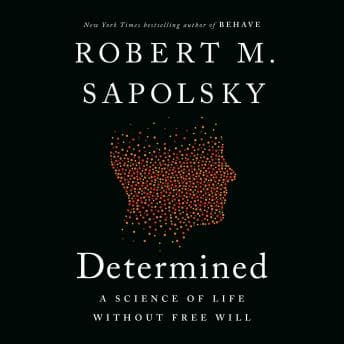

Look, I have a bone to pick with Robert Sapolsky. Not because he's wrong—the man has receipts stacked to the ceiling from decades of neuroscience research. My problem is that he spent 14 hours systematically dismantling every comfortable illusion I had about being a rational agent making choices, and now I'm stuck on the Caltrain at 6:47 AM questioning whether my decision to get a large coffee instead of a medium was ever really "my" decision at all.
Bottom Line: Worth your commute. This is basically Behave but for the philosophical implications, and Sapolsky goes full scorched-earth on free will. The ROI on this audiobook is high if you want your entire worldview recalibrated.
The Case Gets Built Like a Distributed System
Sapolsky doesn't just argue against free will—he constructs a methodical, layer-by-layer demolition. Think of it like debugging: he starts with the obvious surface-level stuff (your neurons fired before you "decided" to move your hand) and then goes deeper into the stack. Childhood environment. Prenatal hormones. The genetic lottery. The culture your great-grandparents lived in. It's the kind of framework that makes you rethink how we raise kids entirely—Raising Good Humans operates from a similar premise about breaking inherited patterns, though with way less neuroscience and way more practical parenting scripts. By the time he's done, you realize there's no layer where a magical "you" exists independently of causation.
The science actually holds up. He walks through the famous Libet experiments, then addresses every objection philosophers have thrown at determinism over the decades. Chaos theory? Handled. Quantum randomness? He explains why it doesn't save free will (randomness isn't the same as agency—your neurons firing randomly doesn't mean YOU chose anything). Emergent complexity? He's got receipts.
What I appreciated is that he doesn't strawman the opposition. He takes the best arguments for free will seriously—compatibilism, the "could have done otherwise" framework, libertarian free will—and then systematically takes them apart. It's like watching someone refactor a legacy codebase: painful to witness, but necessary.
Kaleo Griffith Keeps You Awake Through the Dense Parts
I finished this in about 6 commutes, which for a 14-hour science book is actually impressive. Griffith maintains this energetic, conversational tone that makes dense neurochemistry feel less like a textbook. He's not Ray Porter (need I say more about what that would've been), but he handles the technical material without making you zone out during the dopamine pathway explanations.
The pacing is interesting—Sapolsky writes in this discursive, almost chatty style, jumping between hard science and philosophical tangents, and Griffith leans into that. A few sections required a rewind because my 6 AM brain couldn't process the quantum mechanics bit on first pass, but that's on the content density, not the narrator.
One note: there's a downloadable PDF with charts and diagrams. I never looked at it because I was, you know, commuting, but if you're the type who needs visual aids for scientific concepts, maybe save some chapters for when you can reference it.
The Part Where It Gets Uncomfortable
Here's where Sapolsky earns his keep: he doesn't just prove his point and walk away. The back third of the book tackles the implications. If no one has free will, what does that mean for criminal justice? For praise and blame? For how we treat people who do terrible things?
His argument is basically: once you truly internalize that the person who committed a crime had no more "choice" in the matter than someone who develops epilepsy, you can't justify retributive punishment. You can still protect society—quarantine the dangerous—but the moral framework shifts entirely.
I found myself arguing with him in my head during the walk from Caltrain to the office. (Or did I? Was that "argument" just neurons firing in a pattern determined by my prior exposure to philosophy podcasts and my blood sugar level?) The book does this to you. It gets under your skin.
Who This Is (and Isn't) For
This is not background listening. Don't put this on while debugging production issues—you'll either miss the argument or introduce bugs because you're distracted by determinism. Dedicated focus time or a commute where you can actually pay attention.
Skip this if: you want a quick pop-science overview (this is not "could've been a blog post"), you're looking for comfort, or you're already convinced and don't need 14 hours of evidence.
Perfect for: anyone who read Behave and wanted the philosophical payoff, people who argue about consciousness at parties, engineers who like their arguments airtight, or anyone doing the Caltrain zombie shuffle who wants their worldview productively destabilized.
The Commit Message
Sapolsky convinced me. I didn't want to be convinced—it's way more comfortable believing I'm the author of my choices—but the evidence is overwhelming. The question now is whether I can actually live like someone who believes this. Spoiler: probably not, because my brain wasn't built for it. But at least now I know that my failure to internalize determinism is also... determined.
I'm rating this 4.5 because the science is rigorous, the argument is comprehensive, and it genuinely changed how I think about blame and praise. Knocked off half a star because some sections drag (the philosophy deep-dives get repetitive) and because I'm still slightly mad at Sapolsky for making me question everything. Worth your credit. Worth your commute. Just don't expect to feel the same about anything afterward.







![Steve Jobs [unabridged audiobook] audiobook cover](/_next/image?url=https%3A%2F%2Fcovers.audiobooks.com%2Fimages%2Fcovers%2Ffull%2F9788499923406.jpg&w=1920&q=75)