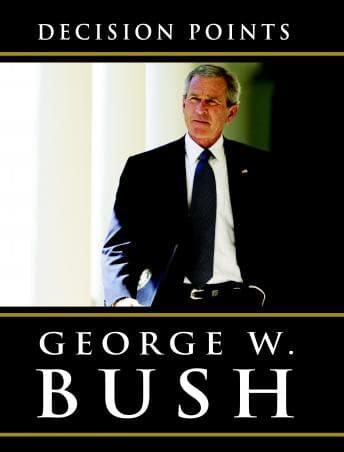
How do you review a president's own version of events when you spent years on the ground executing the decisions he's describing from behind that Oval Office desk?
I wrestled with that question for most of the 20 hours I spent with this book. Couldn't sleep one night - Ranger was snoring, Linda was out cold, and my brain wouldn't shut off after a particularly dense stretch about the Iraq surge. So I just kept listening in the dark, staring at the ceiling, turning over things I'd lived through from a completely different altitude.
The View from 30,000 Feet vs. the View from the Dirt
Let me cut to the chase - this book is structured around decision points (obviously), not chronology, which threw me at first. Bush jumps from his decision to quit drinking to stem cell research to 9/11 to Katrina. The early chapters feel scattered, like someone dumped a box of index cards on the floor and started reading them in whatever order they landed. But once you settle into the rhythm - roughly an hour or two per major decision - it starts making sense. Each chapter is essentially a case study: here's the problem, here's what I was told, here's what I decided, here's what happened.
The 9/11 chapter is genuinely gripping. Bush describes being aboard Air Force One, getting fragmented intelligence, not knowing if more attacks were coming, and making the call to authorize shooting down civilian aircraft. Whether you agree with everything that followed or not, that specific sequence of events - the fog of war from the commander-in-chief's perspective - is worth the listen alone. I've been in situations where information is incomplete and decisions are irreversible. That chapter felt honest to me.
The Iraq chapters are where I had the most... complicated reaction. I did two tours there. I know what those decisions cost at the squad level. Bush presents his reasoning methodically - the intelligence briefings, the diplomatic efforts, the internal debates. He's clearly making his case for history. And I respect the transparency of laying out his thought process, even when I found myself muttering counterarguments into the dark. He acknowledges the WMD intelligence failure directly, which some critics claimed he wouldn't. But there's a sanitized quality to the war sections - the cost is discussed in terms of strategy and policy, not in terms of the guys I knew who didn't come home. That's not necessarily a flaw. It's a president's memoir, not a grunt's memoir. But it's a gap you'll feel if you were closer to the ground.
Ron McLarty Behind the Mic - Competent, Not Electric
Here's the thing about this audiobook: Bush himself narrated an abridged version, and honestly, I can see why some people prefer that one. Bush's Texas drawl and his particular cadence - the way he pauses before a punchline, the slight smirk you can almost hear - that's part of the story. Ron McLarty is a pro. Over 100 audiobook narrations, clear delivery, proper pronunciation of names like Musharraf and Maliki. He handles 20 hours of dense political content without stumbling, which is no small feat.
But McLarty reads this like a narrator, not like a president reliving his own memories. There's a flatness to sections that should crackle - the election night 2000 scene in the Texas Governor's Mansion, for instance, where the networks are calling Florida back and forth. Bush wrote that with real tension and dark humor. McLarty delivers it capably but without the edge it deserves. At 1x speed, some chapters genuinely drag. I bumped to 1.25x (my standard) and it helped considerably. Some of you might want 1.5x for the policy-heavy stretches on PEPFAR or Medicare Part D.
Who This Is Actually For
If you want to understand post-9/11 American decision-making from the top of the chain of command, this is essential listening. Period. Agree or disagree with Bush - and I do both, sometimes in the same chapter - he gives you his reasoning in a way that most political memoirs don't. He's not just telling you what happened. He's telling you what he was thinking and why.
If you're looking for a balanced historical account, this isn't it. It's one man's perspective, and he's got every reason to present himself favorably. Read it alongside other accounts. The Tao Te Ching is about as far from a presidential memoir as you can get, but I kept thinking about it during these sections - there's something in that text about the nature of power and self-justification that cuts right through the kind of careful narrative-building Bush is doing here. If bad pacing kills a book for you and you can't adjust playback speed, the abridged version might be the better call.
If you have zero interest in politics or the 2001-2009 era, skip it. Twenty hours is a serious commitment for content you don't care about.
Mission Debrief
I spent a quarter of my career executing decisions that trace back to this desk. Hearing the reasoning - even filtered through years of reflection and obvious self-interest - filled in gaps I'd been wondering about for over a decade. It's not the whole picture. It's never the whole picture. But it's a piece I needed.
Ranger slept through the whole thing. But I didn't.







![Steve Jobs [unabridged audiobook] audiobook cover](/_next/image?url=https%3A%2F%2Fcovers.audiobooks.com%2Fimages%2Fcovers%2Ffull%2F9788499923406.jpg&w=1920&q=75)