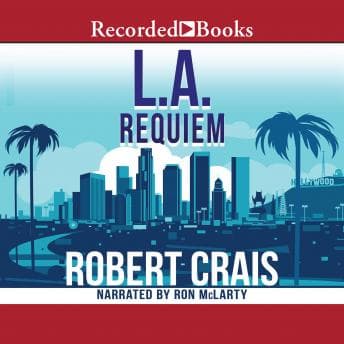

Everyone told me Robert Crais wrote the literary equivalent of beach reads. Fun, breezy, forgettable by the time you towel off. So I came to L.A. Requiem expecting exactly that—something light to get me through a stack of sophomore essays on The Great Gatsby. What I got instead was a sucker punch disguised as a detective novel.
I was wrong. Delightfully, devastatingly wrong.
When Chandler's Ghost Shows Up Uninvited
This is not the Elvis Cole I'd been promised. The wise-cracking PI with the cat and the bad jokes? He's here, sure. But Crais does something unexpected—he sidelines his own protagonist to excavate the soul of Joe Pike, the silent partner who's always been more weapon than man. And suddenly we're not reading a mystery. We're reading a tragedy that happens to have a body count.
The structure alone deserves attention. Crais weaves Pike's origin story through the present-day investigation, and those flashback chapters hit different when you're listening at 11 PM, red pen abandoned, realizing you've been grading the same paragraph for twenty minutes because you needed to know what happened to Pike in that foster home. The Santa Ana winds that Crais keeps invoking aren't just setting—they're metaphor. Everything in this book feels like it's about to catch fire.
This reminds me of what Hemingway said about writing—that the dignity of movement of an iceberg is due to only one-eighth of it being above water. Pike barely speaks. But Ron McLarty makes you hear everything he's not saying.
McLarty Gets Cole, But Does He Get Pike?
Here's where I have to be honest. Some listeners call McLarty's narration superb. Others can't remember him at all. I fall somewhere complicated.
His Elvis Cole is perfect—the sarcasm lands exactly right, that California cynicism mixed with genuine decency. McLarty captures Cole's voice like he's been listening to him for years. But Pike? Pike is harder. The subtle differentiation works most of the time, but there were moments—particularly in the flashback chapters—where I wanted more silence. More weight in the pauses. Pike is a man who communicates in the spaces between words, and occasionally McLarty fills those spaces when he should let them breathe.
That said, the growing desperation as the conspiracy tightens? McLarty builds that beautifully. By the final third, I was walking the lakefront with Denise, completely ignoring her commentary about the neighbor's new landscaping, because the tension had become physically uncomfortable. (She forgave me. Eventually.)
The Ending Problem—Or Is It?
Some readers found the conclusion predictable. "Ho-hum," one reviewer called it. And look—they're not entirely wrong about the mystery mechanics. If you've read enough noir, you'll see certain revelations coming from a mile away.
But here's what those critics missed: the ending isn't about whodunit. It's about what it costs Pike and Cole to find out. The final act is less about surprise and more about watching two men you've grown to care about navigate the wreckage of truth. The prose deserves to be savored here—Crais writes the climax like he's scoring a film, and McLarty's delivery matches that intensity.
My students would hate this. They want twist endings, shock value, the literary equivalent of a jump scare. This is something older. Something that trusts you to feel the weight of consequences rather than just the thrill of revelation.
Who Should Enroll, Who Should Drop
If you loved The Long Goodbye or Devil in a Blue Way, this is your spiritual successor—Crais is working in that tradition while making it entirely his own. That same exploration of moral ambiguity shows up in Lolita, though Nabokov takes it to places infinitely more uncomfortable. If you're coming to this as your first Elvis Cole book, you'll be fine, but you might want to start earlier in the series to appreciate how much darker this entry goes.
Skip this if you need constant action or if you're looking for background listening while cooking dinner. The plot complexity demands attention—I tried listening while grading once and had to rewind twenty minutes because I'd missed something crucial while circling comma splices.
Perfect for: long drives, focused evening sessions, or any time you want to feel like you're reading something that matters. Worth pausing the faculty meeting for. (Sorry, Principal Martinez.)
Mr. Williams's Final Grade
Thirteen and a half hours is a commitment. But unlike most commitments in my life—faculty committees, I'm looking at you—this one pays off. Crais turned what could have been another PI procedural into something approaching literature. Not perfect literature. The Dolan character strains credibility in places, and yes, some of the mystery mechanics are telegraphed. But the emotional architecture is sound, the prose is muscular without being showy, and McLarty—for all my minor quibbles—delivers a performance that keeps you locked in.
This is why we still read the classics. Because sometimes a genre novel transcends its genre. L.A. Requiem doesn't just solve a murder. It asks what we're willing to destroy to protect the people we love—and whether we can live with the answer.